4-Step Account Bucket System for Young Professionals: Lessons from Song Eun-i's 33-Year Savings Habit
 AI-generated image
Key takeaways
Inspired by TV personality Song Eun-i's 33-year savings habit, this guide outlines a 4-step automated account bucket system for young professionals aiming to save 50% of their income. Learn how allocating roles across income, savings, spending, and emergency accounts alongside a 3-day transfer strategy helps curb overspending and build seed money.
As news spread that TV personality Song Eun-i has maintained pension savings for 33 years while saving over 50% of her income, salary management strategies for young professionals starting asset building have gained attention. If your bank account ends up empty on payday due to fixed expenses and credit card bills, you need a system that mechanically blocks overspending rather than relying on willpower. As highlighted in Seoul Shinmun's report, here is a guide to a 4-step account bucket system and automated transfer strategy that helps young professionals save 50% of their net pay, mirroring Song Eun-i's savings method.
1. Financial Insights from TV Personality Song Eun-i's 33-Year Savings Habit
The core of TV personality Song Eun-i's personal finance approach lies not in high investment returns, but in her "save first, spend later" habit of setting aside more than 50% of her income since her debut. Maintaining a consistent long-term savings system without being swayed by short-term market fluctuations or return trends is the essential foundation for building seed money.
As noted in Daum News reports and elsewhere, holding long-term financial products and developing expenditure control habits are powerful ways for young professionals to preserve principal while accumulating wealth. Hastily jumping into high-risk investments like stocks or crypto early in your career can make it difficult to recover if you lose your principal. To grow assets stably, you must start by establishing a solid savings system in the beginning.
 AI-generated image
2. The 4-Step Automated Account Bucket System for Young Professionals
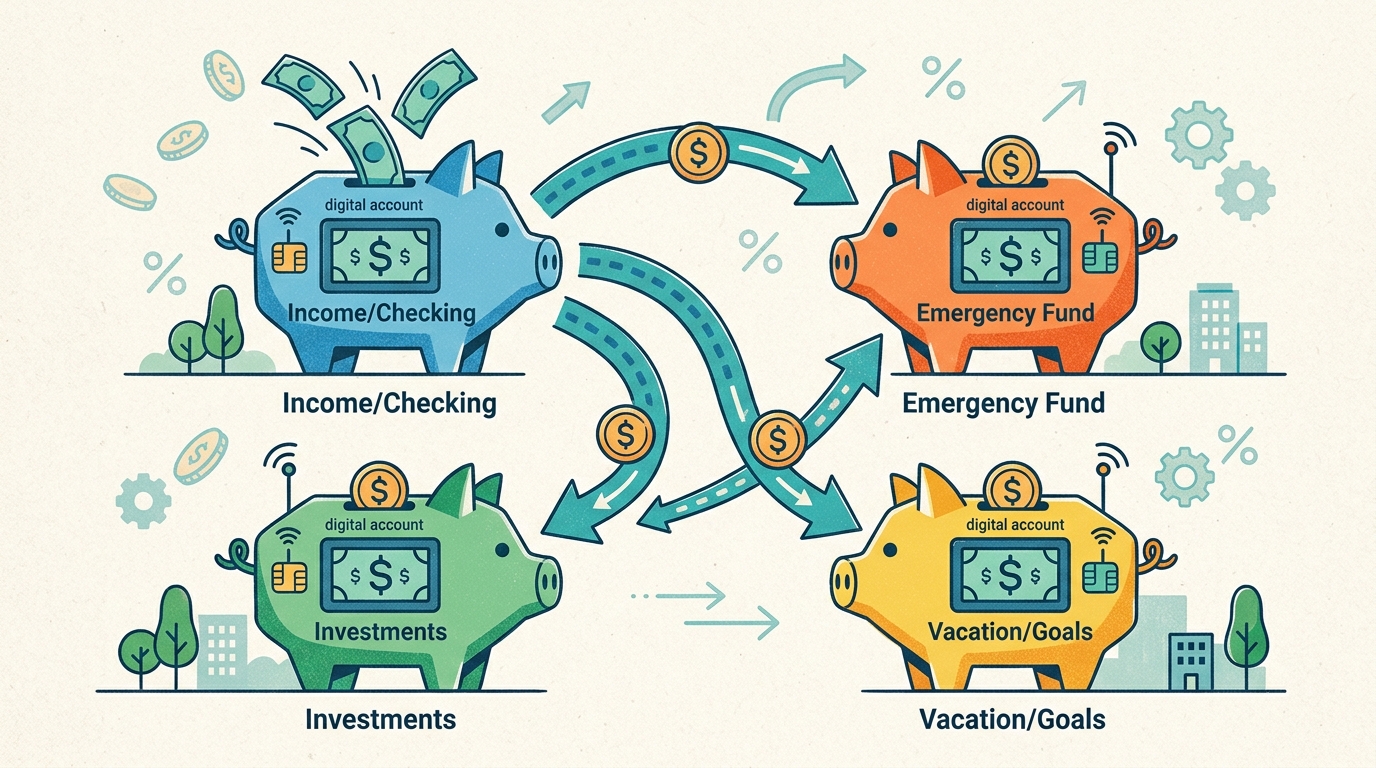
Account bucketing (or account splitting) is a technique that clearly separates funds into four account categories—income, savings, spending, and emergency—to control balances and expenses. It prevents the financial illusions that occur when money is pooled together and helps you intuitively recognize spending limits.
The structure of the 4-account system recommended by financial experts and Toss Feed's guide is as follows:
| Account Type | Key Role | Recommended Account / Product Type | Management Key Point |
|---|---|---|---|
| Income Account | Salary deposit & fixed expense transfers | Checking/checking-like account at commercial bank (fee waiver terms) | Distribute balance down to '0 KRW' after payday |
| Savings/Investment Account | Seed money accumulation & long-term savings | Installment savings, funds, ISA, pension savings | Withdraw first via auto-transfer on payday |
| Spending Account | Living costs & variable expenses | Account linked exclusively to a debit card | Strictly prohibit additional deposits after setting budget limit |
| Emergency Fund Account | Preparation for unexpected expenses | CMA account, high-yield parking account | Build up 3~6 months of monthly living expenses |
- Income Account: The main account where your salary is deposited. Leave only essential fixed expenses like phone bills, utilities, and rent, and immediately distribute remaining funds to other accounts.
- Savings/Investment Account: The account where you transfer your targeted 50% savings goal first. This includes installment savings, housing subscription accounts, and pension savings.
- Spending Account: The account for variable monthly expenses such as food, transportation, and leisure. Link it to a debit card and use funds strictly within the remaining balance.
- Emergency Fund Account: An account reserved for sudden costs such as family occasions or medical bills. High-yield parking accounts that earn daily interest are recommended.
3. Realistic Asset Allocation Ratios to Reach a 50% Net Savings Rate
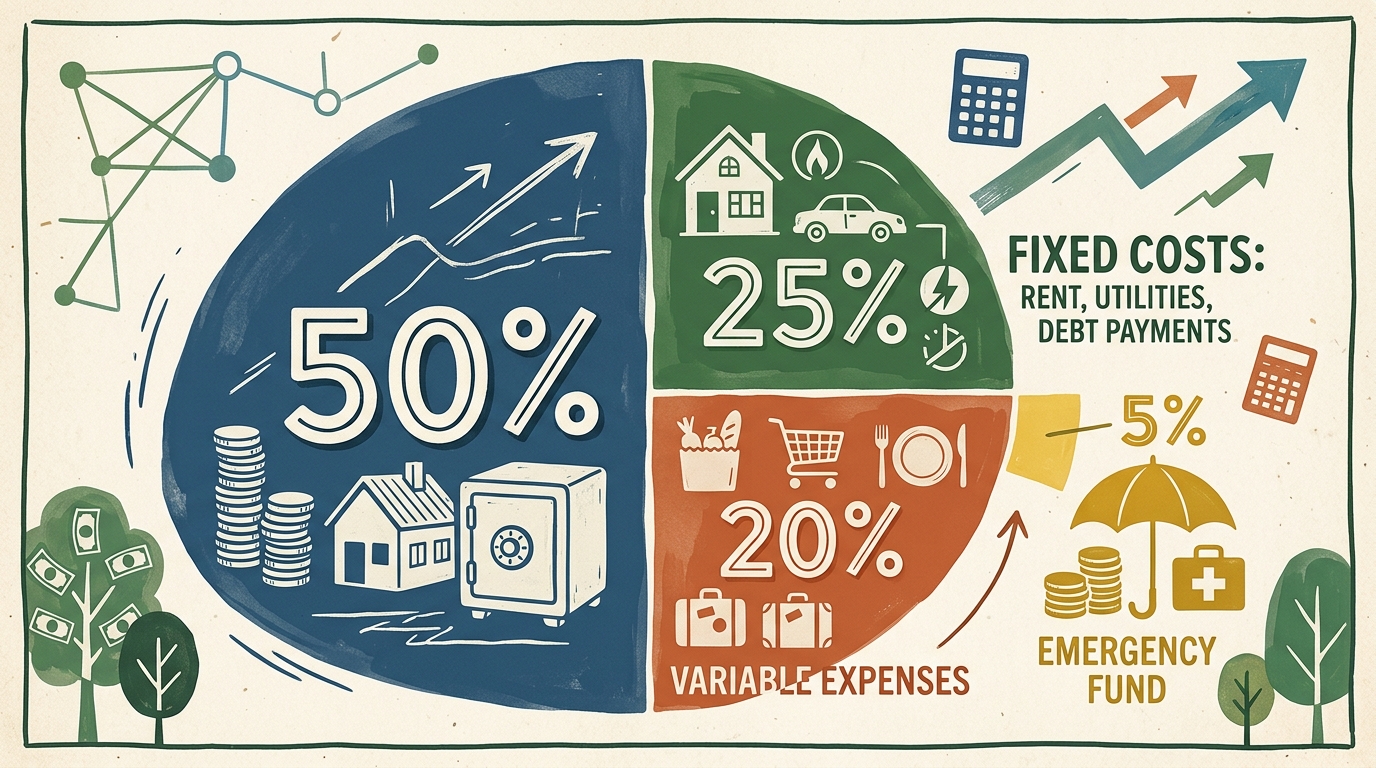
The recommended breakdown for young professionals targeting a 50% savings rate is: 50% savings/investment, 25~30% fixed expenses, 15~20% variable living costs, and around 5% emergency savings. If fixed expenses such as housing are high, starting at a 30~40% savings rate and stepping it up gradually is more realistic than pushing too hard.
Here is an allocation example based on a monthly net income of 2.5 million KRW:
- Savings & Investment (50%): 1.25 million KRW (pre-save into installment savings, ISA accounts, pension savings, etc.)
- Fixed Expenses (25%): 625,000 KRW (rent, utilities, phone bills, insurance, etc.)
- Variable Expenses (20%): 500,000 KRW (food, transportation, daily necessities, leisure)
- Emergency Fund (5%): 125,000 KRW (deposit into a parking account)
As noted in Toss Bank's official guide, setting an overly aggressive savings goal of 70~80% makes the system prone to collapse due to lifestyle strain. The key is to accurately assess your fixed expenses and establish a sustainable savings ratio.
 AI-generated image
4. A 3-Day Payday Auto-Transfer Scenario to Control Spending
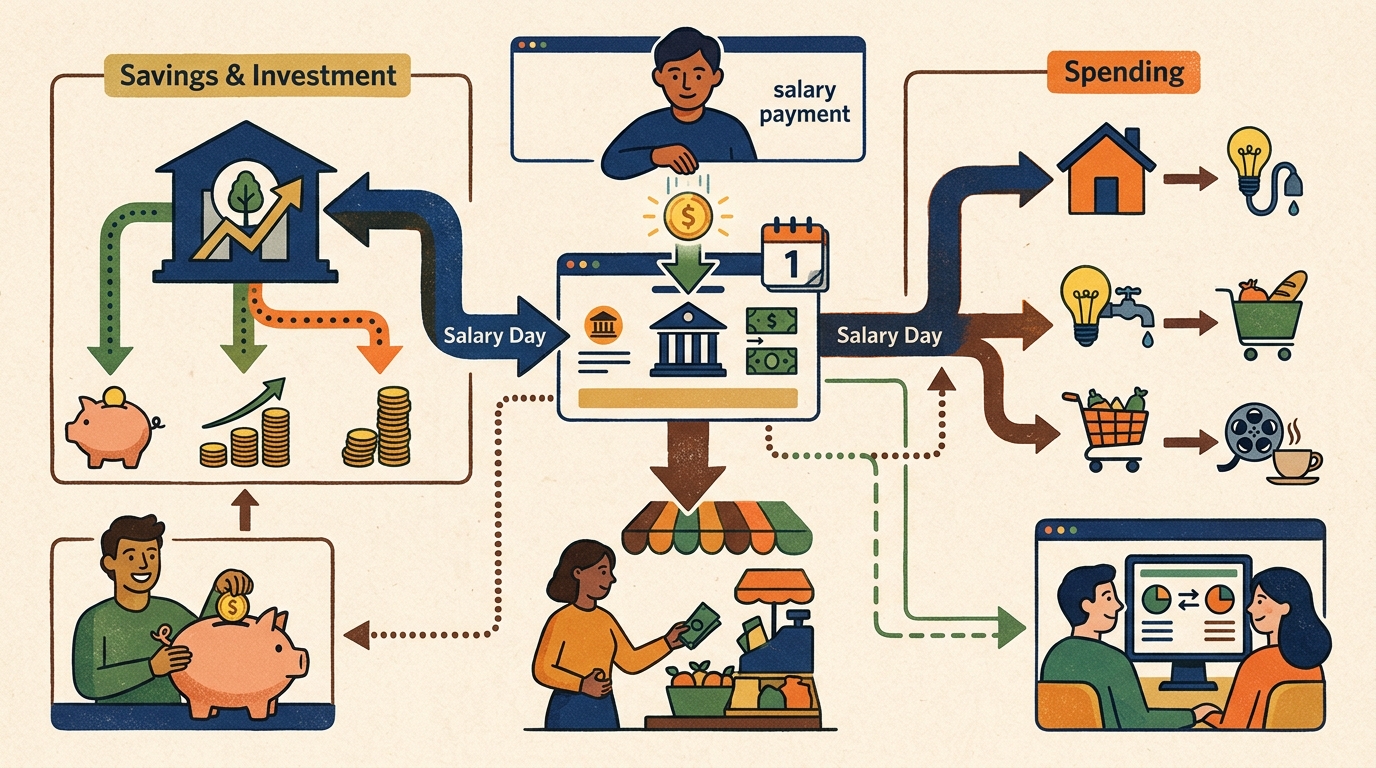
Setting up auto-transfers for savings and fixed costs to complete within 3 days of receiving your paycheck prevents money from simply "vanishing" from your account. Establishing a withdrawal sequence that resets your income account balance to 0 KRW significantly strengthens spending control.
Set up your automated transfer workflow in the following order:
- Payday (Day 1): As soon as the deposit is confirmed, execute an automated transfer of the target amount (50%) to your savings/investment account.
- Day After Payday (Day 2): Process transfers for essential fixed costs such as rent, utilities, and insurance.
- 3rd Day After Payday (Day 3): Move variable living funds to your spending account, and transfer all remaining funds to your emergency account to close out the income account balance at 0 KRW.
Automating this workflow enforces a rule requiring you to live within the amount in your spending account for the month, effectively curbing impulse spending.
5. 3 Key Rules to Prevent Account Bucket System Failure
To maintain an account bucket system long-term and reach a 50% savings goal, you must proactively prevent common mistakes.
First, minimize credit card usage and use a debit card as your primary payment method. Credit card bills arrive a month later, hindering real-time balance tracking in your spending account. It is best to limit credit card use solely to fixed recurring expenses where you receive rewards or discounts.
Second, set your emergency fund target to 3~6 months of monthly living expenses. Securing an emergency reserve of at least 2 million to 3 million KRW as a young professional prevents you from having to break installment savings contracts when unexpected costs arise.
Third, stick to the rule of never pulling extra cash from your savings or emergency accounts even if your spending account balance runs low. When running short, train yourself to immediately cut back variable expenses for the remainder of the month.
(This information is written based on general financial and money management knowledge and does not constitute a recommendation or investment advice for specific financial products. When signing up for financial products, please thoroughly review your personal financial situation and product terms.)
Frequently asked questions
Q. Is saving 50% of income realistic on a net monthly salary of 2 to 2.3 million KRW?
It depends on factors such as living with parents or fixed housing costs. If housing expenses are high, rather than forcing a 50% rate right away, start at 30–40% and gradually increase your savings rate as you reduce fixed expenses.
Q. Should I completely stop using credit cards when I start splitting my accounts?
No. It is better to lower your credit limit and use credit cards solely for fixed recurring payments like phone bills and utilities that offer discounts, while using a debit card for daily variable expenses to immediately track your balance.
Q. How much money should I keep in an emergency fund account?
For young professionals, aiming for 3 to 6 months of living expenses—roughly 2 million to 3 million KRW—is recommended. Storing it in a CMA account or high-yield parking account that earns daily interest is most efficient.
Q. Should the 50% savings goal all be deposited into regular bank installment savings accounts?
No. After first allocating funds to stable savings and housing subscription accounts, you can diversify a portion into long-term wealth-building vehicles such as tax-advantaged ISAs or pension savings.