Apartment Reconstruction Contribution Fee Calculation: Proportion Rate, Rights Value, and Jamsil Jugong Unit 5 Case Study
 AI-generated image
Key takeaways
Apartment reconstruction contribution fees are calculated using the formula: 'Union Member Sales Price - Individual Rights Value (Previous Asset Appraised Value × Proportion Rate)'. Even if the proportion rate is below 100%, a refund can still occur depending on the previous asset value. For instance, as of September 2026 at Jamsil Jugong Unit 5, a 34-pyeong owner applying for a new 84㎡ unit under an estimated 86.15% proportion rate expects a refund structure, though fluctuations in construction costs and total project expenses will ultimately determine the final settlement.
In real estate reconstruction projects, the amount a property owner must pay or receive back is determined by three key factors: the appraised value of the previous asset, the union member proportion rate, and the union member sales price. Regardless of how high current market prices are, the legal criteria for calculating rights value depend on appraised values and project feasibility. Understanding these consistent calculation principles is essential to avoid unexpected financial hardship.
We have examined in detail how proportion rates and rights value affect actual cash flow, including the case of Jamsil Jugong Unit 5 Apartment, a landmark reconstruction complex in Seoul.
What Is the 3-Step Core Formula for Calculating Reconstruction Fees?
The reconstruction contribution fee is calculated using the formula: 'Union Member Sales Price - Individual Rights Value'. To determine the rights value, you must first multiply the appraised value of the previous asset by the proportion rate, which gauges the project's profitability.
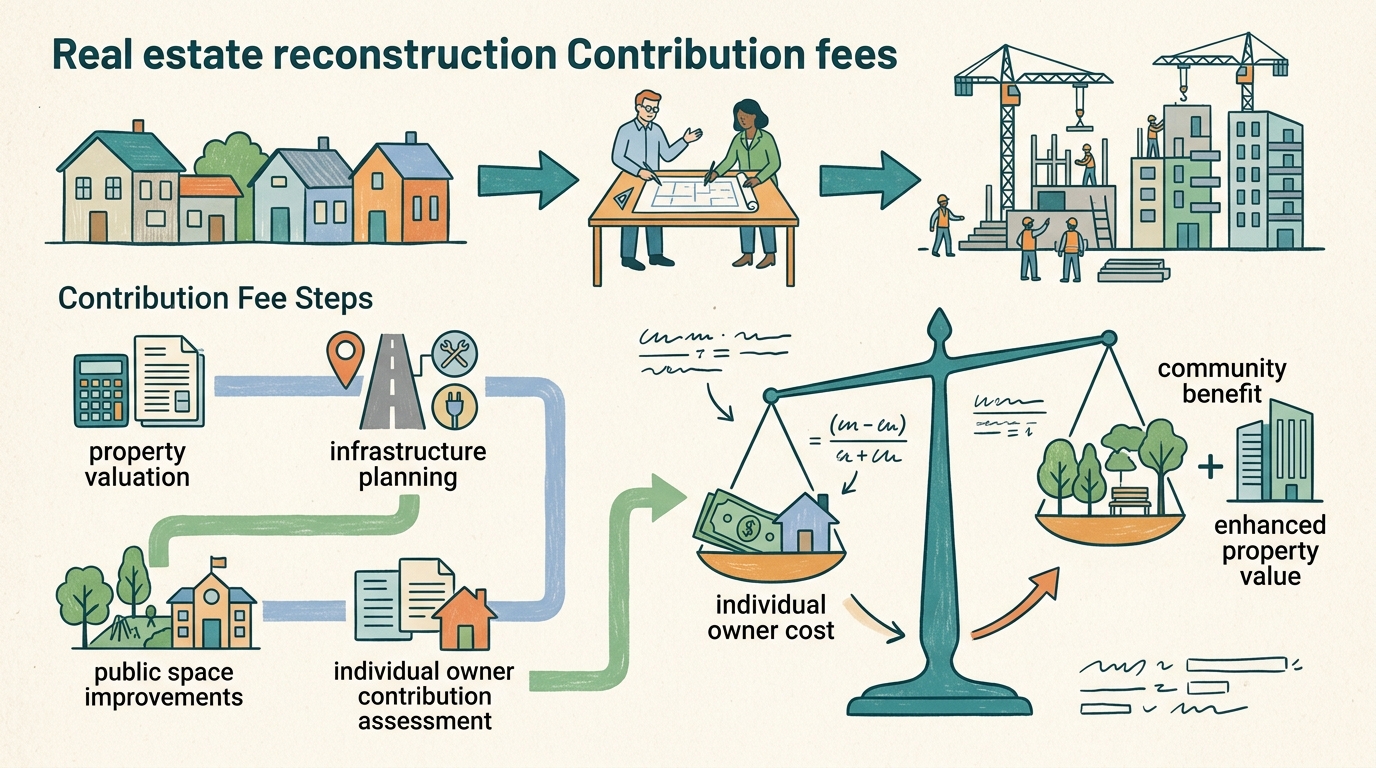
The overall calculation flow follows these 3 steps:
- Calculate the Union Member Proportion Rate: Calculate net profit by subtracting total project costs (construction, financing, etc.) from total project revenues, then divide this by the total appraised value of all union members' previous assets.
- Determine Individual Rights Value: Multiply the appraised value of your existing apartment (previous asset value) by the union member proportion rate.
- Determine Final Contribution Fee (or Refund): Subtract individual rights value from the union member sales price of the new apartment. A positive (+) result indicates an additional contribution fee to pay, while a negative (-) result indicates a refund to receive.
Summary of the 3 Key Formulas for Contribution Fee Calculation
| Calculation Step | Calculation Formula | Description & Characteristics |
|---|---|---|
| Step 1: Proportion Rate (%) | (Total Sales Revenues - Total Project Expenses) ÷ Total Appraised Value of Previous Assets × 100 | Indicator showing the overall profitability of the project |
| Step 2: Rights Value | Appraised Value of Previous Asset × Proportion Rate | Practical asset value contributed by the union member to the project |
| Step 3: Contribution Fee / Refund | New Unit Sales Price for Union Member - Individual Rights Value | (+) value means additional payment required, (-) value means refund |
According to legal expert analysis, many union members mistake current market transaction prices for rights value. However, appraised values follow the Ministry of Land, Infrastructure and Transport's standard land prices and conservative appraisal criteria, so they are typically calculated differently from market transaction prices.
Is It Always a Loss If the Proportion Rate Drops Below 100%?
A proportion rate falling below 100% does not automatically mean a loss for property owners. This is because the proportion rate works interactively with the level of previous asset appraised values and general sales prices. The proportion rate is merely an indicator of relative project efficiency; it does not independently determine an individual's actual financial benefit.
Many owners consider a 100% proportion rate as a safety threshold, but this is largely an optical illusion. If previous asset appraised values are intentionally set high, the denominator becomes larger, which can lower the proportion rate to around 85~90%. Even so, because the baseline appraised value itself is high, the final rights value remains substantial.
Conversely, if previous asset appraised values are set low, the proportion rate may rise above 110%, but multiplying it by a lower initial appraisal produces a similar resulting rights value.
Practical Impact of Construction Cost Hikes on Proportion Rates
The real issue is when the proportion rate drops not due to appraisal adjustments, but because of a sharp rise in total project expenses caused by escalating raw material and labor costs. When higher construction costs inflate total project expenses, the proportion rate falls, directly shrinking union members' individual rights values and raising additional contribution fees.
What Is the Impact of Construction Cost Changes on Fees and Refunds for Jamsil Jugong Unit 5?
As of September 2026, Jamsil Jugong Unit 5 Apartment, which has obtained business implementation plan approval and is proceeding with the union member housing application stage, is a prime example illustrating the fee structure of a large-scale reconstruction project. Based on an estimated proportion rate of 86.15%, an owner of a former 34-pyeong unit applying for a new 84㎡ unit is projected to receive a refund worth hundreds of millions of KRW.
According to public data reported by Newspim and Housing Watch, estimated figures are as follows:
Estimated Figures for Jamsil Jugong Unit 5 Project (As of September 2026)
- Project Scale: Reconstruction from existing 3,930 units to up to 65~70 floors, total 6,411 units
- Estimated Proportion Rate: 86.15%
- Estimated Appraised Value for Existing 34-Pyeong Unit Owner: Approx. 3.799 billion KRW
- Individual Rights Value Calculation: 3.799 billion KRW × 86.15% = Approx. 3.273 billion KRW
- New 84㎡ Union Member Sales Price: Set around 2.7 billion~3.0 billion KRW
- Expected Refund: Rights Value (3.273 billion KRW) - Union Member Sales Price (Approx. 2.8 billion KRW) = Approx. 470 million KRW refund
However, final numbers remain subject to change depending on construction cost negotiations. How the gap between the contractor consortium's requested construction cost (over 10.6 million KRW per 3.3㎡) and the union's proposal (around 9.8 million KRW per 3.3㎡) is resolved will alter total project expenses at the final management and disposition plan stage. An increase of roughly 800,000 KRW per 3.3㎡ in construction cost raises overall project expenses, lowering the proportion rate. Consequently, expected refunds may shrink or additional contribution fees for larger units may increase.
Calculating Your Own Apartment Reconstruction Fee
To estimate the reconstruction fee for your own apartment in advance, locate three key indicators in the estimated contribution fee notice provided by your union and apply them.
4-Step Self-Calculation Simulation
- Check Previous Asset Appraised Value: Check the appraised value of your property evaluated by certified appraisers.
- Check and Apply Proportion Rate: Multiply by the union's estimated proportion rate to calculate your rights value.
- Example: Previous Asset 1.0 billion KRW × Proportion Rate 95% = Rights Value 950 million KRW
- Check Union Member Sales Price for Desired Unit Size: Identify the union member sales price for the new unit size you wish to apply for.
- Example: New 84㎡ Union Member Sales Price = 1.2 billion KRW
- Calculate Final Contribution Fee Difference: Subtract rights value from union member sales price.
- Example: 1.2 billion KRW - 950 million KRW = 250 million KRW (Additional Contribution Fee required)
If the rights value is less than the union member sales price, you must secure the shortfall as a contribution fee through cash or loans. Conversely, if the rights value exceeds the sales price, you will receive the difference back as a refund.
※ The numbers and calculation methods discussed in this article are provided for general informational purposes to help understand reconstruction mechanisms. Individual contribution fees and refunds may vary depending on appraisal results, union articles, contractor terms, and management/disposition plan approvals from governing local authorities. Please confirm precise details through official union notices and relevant authorities.
Frequently asked questions
Q. Is it always a loss if the proportion rate drops below 100%?
Not necessarily. The proportion rate is a relative ratio among total project revenues, project expenses, and the total appraised value of previous assets. If the previous asset appraisal itself was set high, the final rights value can remain high even with a proportion rate under 100%, meaning it is not automatically a loss.
Q. Why is the rights value different from the current apartment market price?
Market prices reflect asking prices and market expectations, whereas the appraised value used to calculate rights value is evaluated based on conservative legal standards and official land prices, often resulting in an amount lower than the current market price.
Q. Do I have to pay taxes if I receive a reconstruction refund?
Since a refund represents the liquidating settlement of a portion of your existing property asset, it may be subject to capital gains tax. Taxation status and amounts depend on your original acquisition price and settlement ratio, so consulting a tax professional is recommended.
Q. How does my contribution fee change if construction costs increase?
If construction costs rise due to contractor contracts or material cost hikes, total project expenses increase. A drop in the proportion rate caused by higher project expenses reduces union members' rights value, which in turn increases additional contribution fees or reduces expected refunds.