Why Does Long-Term Investment in Leveraged ETFs Fail? The Mechanics of Volatility Drag
 AI-generated image
Key takeaways
Because leveraged ETFs reset daily to track N times the underlying asset's daily return, market fluctuations lead to 'volatility drag' that erodes principal—even when the index returns to its starting point. Combined with rollover costs and swap fees, leveraged ETFs should be used strictly for short-term trading rather than long-term dollar-cost averaging.
Have you ever experienced a situation where the market index moved up and down only to return to where it started, yet your leveraged ETF account remained deep in the red? As of September 2026, many investors who jumped into leveraged products seeking quick profits are watching their wealth erode. The structural cause eating away at your assets when holding leveraged ETFs for the long haul is none other than 'volatility drag' (negative compounding).
Why Is My Account Down by Half When the Index Is Unchanged?
This happens because leveraged ETFs are designed to track N times the 'daily return', not the cumulative return over a period. Even if the underlying index returns to its starting level, daily price volatility continuously shrinks your principal.
In 2026, financial authorities permitted the listing of single-stock 2x leveraged ETFs, prompting a surge of retail investors into leveraged products targeting stocks like Samsung Electronics and SK Hynix. However, the market took a severe hit—enough for the Financial Supervisory Service to issue a consumer warning. Over roughly four months following listing, while the underlying stocks fell only 4.5%~9.2%, 2x leveraged products crashed by -30% to -50%. A detailed case study can be found in the Edaily News article.
 AI-generated image
What Is the Mathematical Mechanism Behind Volatility Drag and Daily Rebalancing?
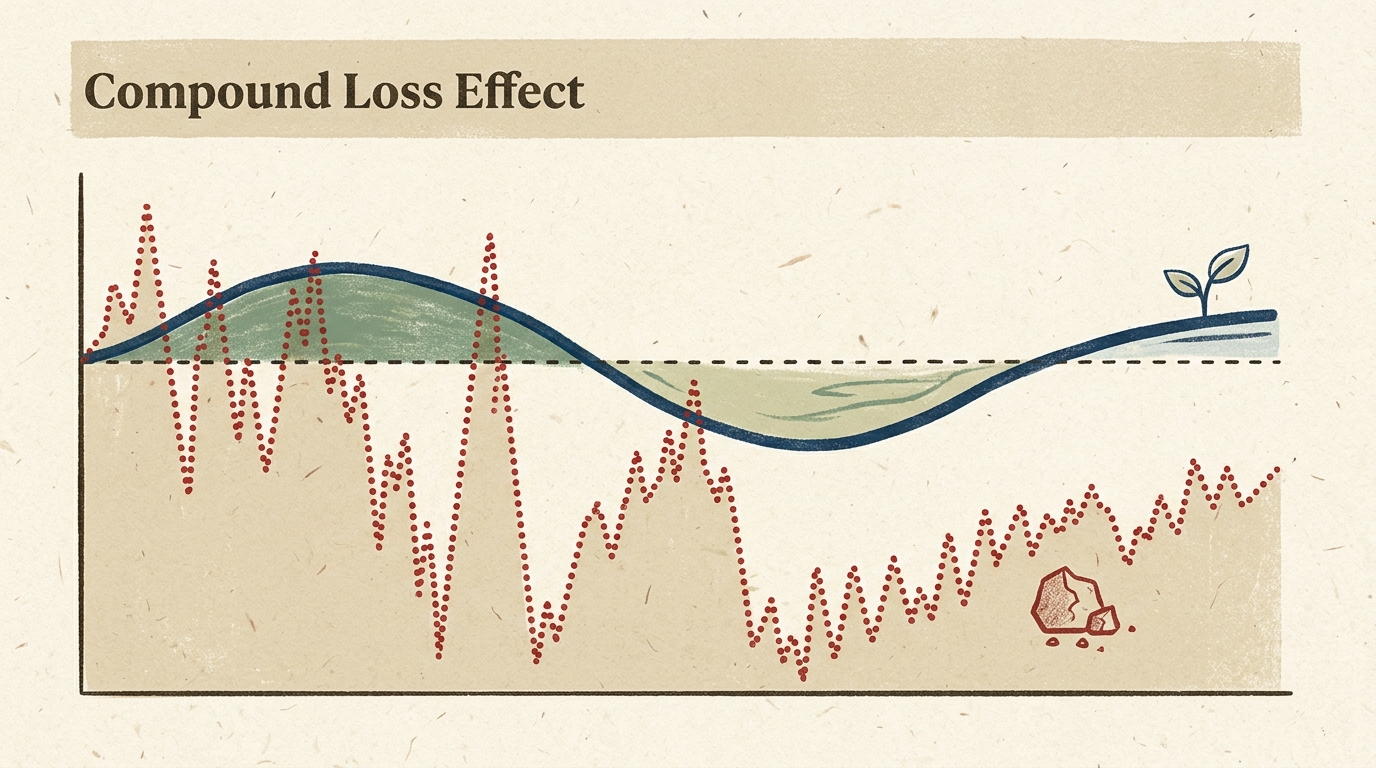
Volatility drag (negative compounding) is a mathematical phenomenon where repeated price rises and falls lower the baseline value of your capital, accumulating losses over time. Because leveraged ETFs undergo 'daily rebalancing' after every trading session to reset to their target multiplier, this effect is especially pronounced.
Comparing principal changes numerically makes this clear:
| Category | Underlying Asset Change | Underlying Asset Balance | 2x Leverage Change | 2x Leverage Balance |
|---|---|---|---|---|
| Principal | - | 100,000 KRW | - | 100,000 KRW |
| Day 1 (Gain) | +10.00% | 110,000 KRW | +20.00% | 120,000 KRW |
| Day 2 (Loss) | -9.09% | 100,000 KRW (Recovered) | -18.18% | 98,184 KRW (-1.82%) |
| High Volatility Example | +30% then -30% | 91,000 KRW (-9.00%) | +60% then -60% | 64,000 KRW (-36.00%) |
When the underlying asset jumps +10% and then drops -9.09%, it exactly restores the 100,000 KRW principal. In contrast, the 2x leveraged ETF rises to 120,000 KRW on Day 1 and then loses 18.18% on Day 2, ending at 98,184 KRW. Even though the underlying asset broke even, the leveraged account shows a loss. The larger the volatility, the faster losses balloon.
Why Is Long-Term Leveraged Trading So Fatal in Range-Bound Markets Like the KOSPI?
In steady uptrending markets like US equities, 'positive compounding' can work in your favor, yielding exceptional returns on leveraged products. However, in range-bound (sideways) markets like the KOSPI, where prices fluctuate repeatedly within a tight band, volatility drag deals a direct blow.
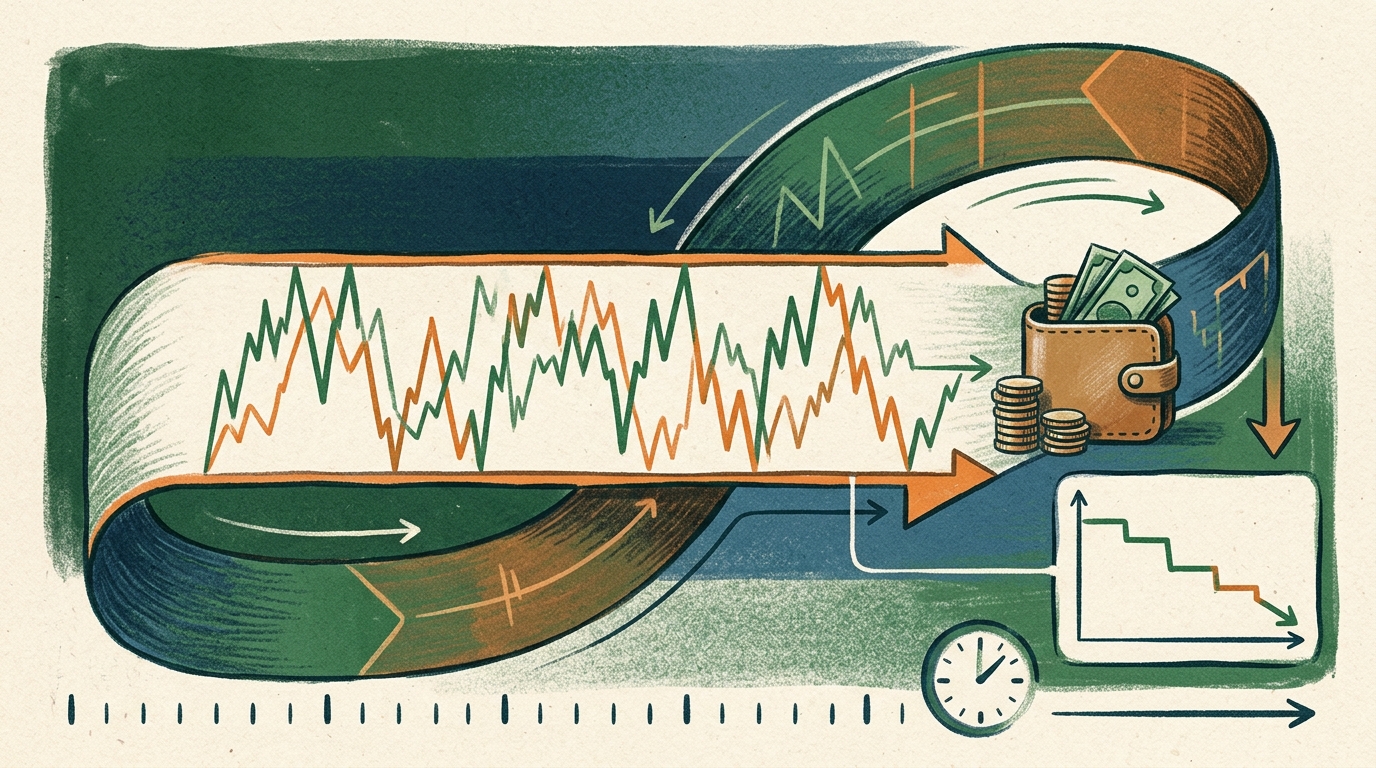
While spot stock investors preserve their capital during sideways trading, leveraged investors see their balances continuously chipped away due to daily rebalancing after every swing. Holding leveraged products long-term in a range-bound market is essentially letting your portfolio bleed out bit by bit every day.
 AI-generated image
Can Dollar-Cost Averaging (DCA) Overcome Leveraged ETF Losses in a Bear Market?
It is extremely difficult. While dollar-cost averaging (DCA) can lower your average cost basis in individual stocks or traditional index ETFs, leveraged ETFs plagued by volatility drag follow a completely different logic.
When underlying assets enter a downtrend, leveraged ETF losses accelerate exponentially faster. Even if you inject additional cash into an already heavily damaged account, a subsequent drop applies volatility drag to the entire enlarged principal, doing nothing more than accelerating the pace at which your capital vanishes. Additional precautions can be reviewed in the Toss Feed article.
What Are the Three Hidden Costs (Expense Ratio, Rollover Cost, and Swap Fees)?
Another major issue is the presence of invisible costs deducted daily from your account, over and above the advertised expense ratio.
- High Management Expense Ratio: Unlike traditional passive ETFs with annual fees around 0.01%~0.05%, leveraged ETFs charge high fees ranging from 0.5%~0.9% annually.
- Futures Rollover Costs: To maintain target leverage multipliers using derivatives (futures), funds incur 'rollover costs' when replacing expiring futures contracts.
- Swap Fees and Interest Expenses: When entering swap agreements with brokerages to match leverage targets, funds incur financing costs tied to benchmark interest rates such as US SOFR or Korean CD rates.
A detailed breakdown of these secondary expenses can be found in the Pension Letter post.
What Are the Proper Trading Rules and Mandatory Requirements for Leveraged ETFs?
Leveraged ETFs should never be treated as long-term DCA vehicles; they are tools designed for short-term directional trading (swing and day trading) when a clear trend is present.
To protect retail investors from uncontrolled losses, Korean financial regulations impose strict requirements on trading leveraged ETPs (ETFs/ETNs):
- Minimum Deposit Requirements: Index leveraged ETPs require a minimum deposit of 10 million KRW, while single-stock leveraged ETPs require a cash deposit of 30 million KRW or more.
- Mandatory Pre-Education Course: Investors must complete a pre-education course on the Korea Institute of Financial Investment website and register the completion certificate number with their brokerage before placing orders. (1 hour for index-based 'Leveraged ETP Guide', and 2 hours total including supplementary modules for single-stock leveraged ETPs.)
While leveraged products can serve as powerful short-term return engines, jumping in without understanding volatility drag and hidden fee structures can easily destroy your portfolio. Investors must avoid long-term holding and maintain strict stop-loss principles.
Frequently asked questions
Q. Why is my leveraged account negative when the index returned to its original price?
Leveraged ETFs rebalance daily to track N times the asset's daily return. When prices fluctuate repeatedly, 'volatility drag' lowers the baseline calculation point, causing accumulated losses even if the index breaks even.
Q. Haven't some investors made huge fortunes holding leveraged ETFs like TQQQ or QLD long-term?
In extraordinary bull markets like the US Nasdaq's sustained long-term uptrend, 'positive compounding' can generate outsized returns. However, prolonged sideways markets or severe crashes pose a risk of catastrophic, unrecoverable account drawdown.
Q. Can't I lower my average cost basis by dollar-cost averaging (DCA) into a losing position?
Averaging down in leveraged products amplifies volatility drag losses during a market decline. It is extremely risky because daily rebalancing decays capital much faster than DCA can lower your average cost basis.
Q. Why is my order failing when trying to buy leveraged ETFs?
To trade Korean leveraged ETPs, you must complete mandatory pre-education through KIFI (1 hour for index-based, 2 hours total for single-stock) and register your completion number with your broker. You must also meet minimum deposit requirements (10 million KRW for index-based, 30 million KRW cash for single-stock).