Temporary Public Holiday Rules and Holiday Pay Calculation Guide
 AI-generated image
Key takeaways
Government-designated temporary public holidays are mandatory paid holidays for workplaces with 5+ regular employees. Working on these days grants a 150% allowance for up to 8 hours and 200% beyond that. Forcing annual leave deductions on temporary holidays is illegal, and substituting holidays requires a written agreement with employee representatives.
Temporary public holidays designated by the government, such as Armed Forces Day, do not apply uniformly to all workplaces. Whether you receive paid time off or how much additional allowance you earn if you work depends on your company's regular employee headcount and your pay structure (salaried, hourly, or daily). Here is a detailed breakdown of the criteria for temporary public holidays and how to calculate holiday work allowance.
Legal Effect of Temporary Public Holidays and the 5-or-More Employee Rule
Public holidays for government offices and temporary public holidays designated by Presidential Decree are legally mandated as paid holidays only for workplaces with 5 or more regular employees. Workplaces with fewer than 5 employees are not legally required to provide paid holidays.
Under Article 55, Paragraph 2 of the Labor Standards Act, which expanded government holiday rules to private enterprises, businesses with 5 or more employees must grant employees paid leave on temporary public holidays.
Conversely, workplaces with fewer than 5 employees are exempt from this provision. Unless specified as a holiday in employment rules or employment contracts, temporary public holidays are treated as normal working days. This is why working on these days in smaller workplaces does not trigger statutory holiday overtime pay. For detailed administrative interpretations and specific regulations, check the National Law Information Center.
How to Calculate Holiday Pay for Working on Temporary Holidays
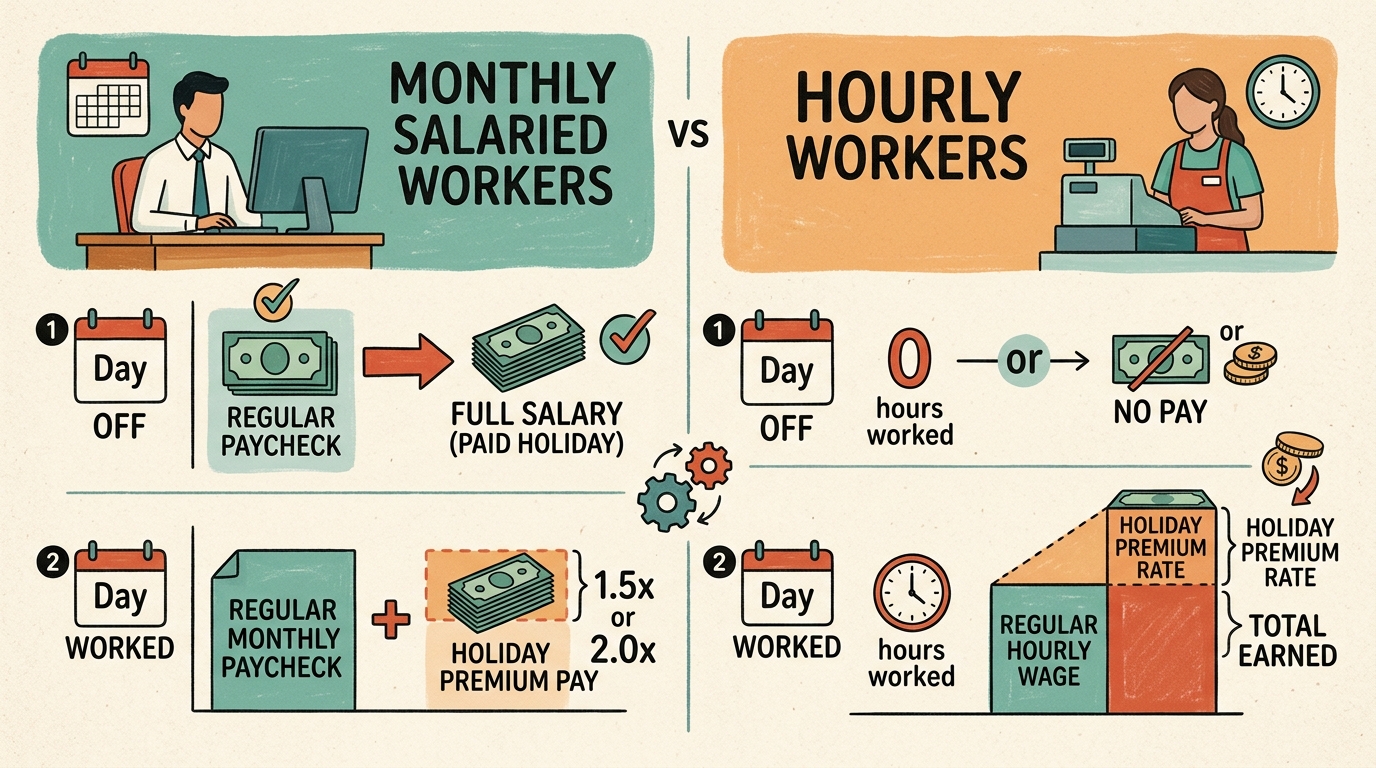
If you work on a temporary public holiday at a workplace with 5 or more regular employees, you are entitled to 150% of your ordinary wage for hours worked up to 8 hours, and 200% for any hours exceeding 8 hours. The final calculation formula depends on whether you are salaried, hourly, or daily paid.
- Salaried Workers: The base salary already includes 100% pay for holidays each month. If you work up to 8 hours on a public holiday, you receive an extra 150% of your ordinary hourly wage (ordinary hourly wage × hours worked × 1.5) as additional holiday pay on top of your regular monthly salary.
- Hourly and Daily Workers: Even if you take the day off, you receive paid holiday pay (100%) for your daily scheduled working hours. If you work on this day, you receive your paid holiday pay (100%) plus holiday work allowance (150%) for the actual work performed, totaling 250%.
| Pay Structure | Payment if Off on Holiday | Payment if Working (Up to 8 Hours) | Additional Allowance Paid |
|---|---|---|---|
| Salaried (5+ employees) | Regular monthly salary (includes 100%) | Monthly salary + 150% of ordinary wage | 150% of ordinary wage |
| Hourly/Daily (5+ employees) | Paid holiday allowance (100%) | Paid holiday allowance (100%) + Holiday work pay (150%) = 250% | 150% of ordinary wage |
| Under 5 employees | Unpaid (unless specified otherwise) | Regular wage (100%) | No extra allowance (100%) |
For practical cases and detailed calculation formulas, refer to HR resource materials such as the Shiftee HR Blog.
 AI-generated image
Legal Requirements for Mandatory Annual Leave Deduction and Holiday Substitution
Deducting an employee's paid annual leave for taking a day off on a temporary public holiday is illegal. To practice "holiday substitution"—working on the holiday and taking off on another regular workday instead—a company must establish a written agreement with employee representatives to be legally valid.
- Prohibition of Forced Annual Leave Deduction: While companies previously substituted public holidays with annual leave, legal amendments have established public holidays themselves as statutory paid holidays. Therefore, forcing employees to consume annual leave on temporary public holidays violates the law. Even if an employee submitted annual leave before a date was officially declared a temporary public holiday, that request is automatically canceled upon designation, granting them paid holiday status without deducting annual leave.
- Requirements for Lawful Holiday Substitution: To have employees work on a temporary public holiday and substitute it with another working day due to business needs, employers must comply with the proviso clause of Article 55, Paragraph 2 of the Labor Standards Act. This requires a "written agreement with employee representatives," not individual verbal consent. The substitute holiday must also be notified at least 24 hours in advance. If these conditions are met, holiday work is converted into regular weekday work, relieving the employer from paying holiday premium rates (1.5x). Related Q&A examples can be found on the Seoul Association of Social Workers Labor Board.
Overlap with Unpaid Off-Days and Essential Checklist for Employers and Workers
If a temporary public holiday falls on an unpaid off-day (e.g., Saturday), employers are not required to pay duplicate holiday pay.
According to Supreme Court precedents and Ministry of Employment and Labor administrative interpretations, unpaid off-days carry no obligation to perform labor in the first place, meaning no double-pay obligation arises. How off-duty days for shift workers overlap with temporary public holidays depends on internal workplace employment rules or collective bargaining agreements.
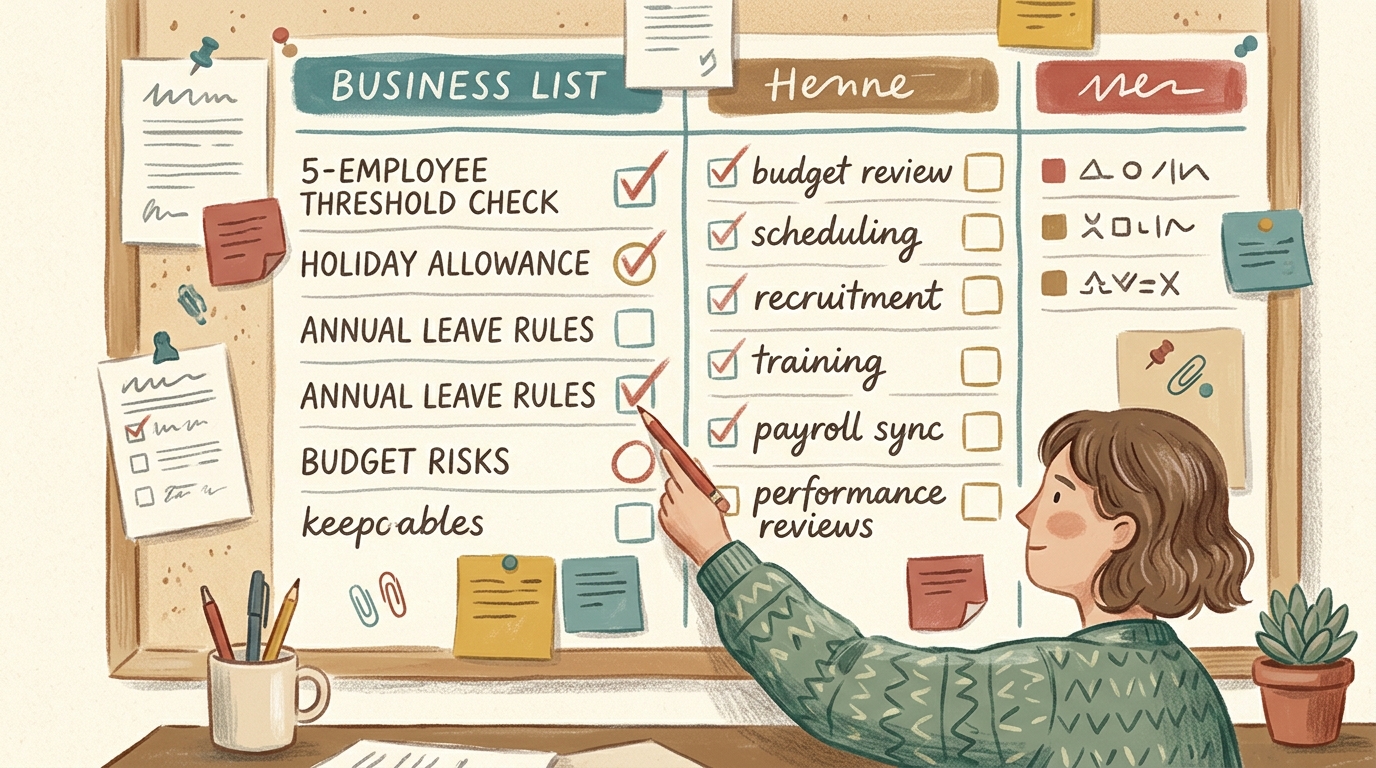
Key practical checklist items to verify include:
- Confirming regular employee headcount (5 or more, including part-time and short-term workers)
- Pre-calculating pay based on pay structures (salaried, hourly, daily)
- Ensuring automatic cancellation and prevention of annual leave deduction for pre-filed leave
- Preparing a written agreement with employee representatives if holiday substitution is applied
It is recommended to double-check specific employment rules and resolve potential labor disputes through legal experts, the Ministry of Employment and Labor counseling center, or local labor offices.
 AI-generated image
Frequently asked questions
Q. Are workplaces with under 5 employees required to take temporary public holidays off?
No. Workplaces with fewer than 5 regular employees are exempt from statutory public paid holiday requirements under the Labor Standards Act. Unless specified otherwise in employment rules or contracts, temporary public holidays are treated as normal working days.
Q. If a day I already requested annual leave for becomes a temporary public holiday, is my annual leave deducted?
No. Annual leave requested prior to the designation is automatically canceled once the date becomes a public holiday, ensuring you receive statutory paid holiday status without deducting annual leave.
Q. How much extra pay do salaried employees get for working on a temporary public holiday?
Salaried workers at workplaces with 5+ employees already have 100% holiday pay included in their base salary. Working on a holiday yields an additional 150% of their ordinary hourly wage for up to 8 hours (200% for hours exceeding 8 hours) on top of their regular salary.
Q. Is it legally allowed for a company to ask employees to take off on a weekday instead of a temporary holiday?
Yes, if lawful holiday substitution procedures are followed. This requires a written agreement with employee representatives (not individual consent) and notifying employees of the substitute day at least 24 hours in advance.