Korean Winter Street Food: 2026 Prices & Tourist Tips
Key takeaways
Korean winter street food prices in 2026 average ₩1,000 to ₩2,000 for classics like bungeoppang, hotteok, and eomuk. Foreign credit cards and foreign bank transfers are not accepted at mobile carts, making Korean Won cash essential for tourists. Location tracking relies on crowd-sourced apps like 3 Dollar in My Pocket or designated Seoul market districts.
Finding authentic Korean winter street food requires understanding localized payment barriers, seasonal cart locations, and recent price shifts. As of late 2026, standard fish-shaped pastry (bungeoppang) prices hover around 1,000 KRW for one or 2,000 KRW for three pieces, while specialized tourist districts charge higher rates. Standard informal mobile street stalls in South Korea cannot process foreign credit cards, Apple Pay, or foreign bank transfers, making physical cash indispensable for visitors. This breakdown covers item-by-item costs, real-time cart tracking methods, public transit rules, and street stall etiquette.
Korean Winter Street Food Costs (2026 Price Index)
| Snack Name (English & Korean) | Standard Street Stall Price (2026) | Tourist Area Price (Myeongdong / Gangnam) | Primary Ingredients & Key Flavors |
|---|---|---|---|
| Bungeoppang (붕어빵) | ₩1,000 for 1 / ₩2,000 for 3 | ₩2,000 – ₩2,500 each | Sweet red bean paste (pat) or custard cream inside crisp batter |
| Hotteok (호떡) | ₩1,500 – ₩2,000 | ₩2,500 – ₩3,500 | Yeast dough pancake stuffed with brown sugar, cinnamon, and seeds |
| Gyeran-ppang (계란빵) | ₩1,500 – ₩2,000 | ₩2,500 – ₩3,000 | Oval loaf of sweet cornmeal batter baked with a whole fresh egg inside |
| Eomuk / Odeng (어묵 / 오뎅) | ₩1,000 – ₩1,500 per skewer | ₩2,000 per skewer | Folded fish cake skewer simmered in savory radish and kelp broth |
| Gun-goguma (군고구마) | ₩3,000 – ₩5,000 (per bag) | ₩5,000 – ₩7,000 | Slow-roasted sweet potatoes cooked in drum barrel ovens |
Essential Korean Winter Street Snacks & 2026 Price Breakdown
Street food prices in South Korea have adjusted noticeably over recent seasons, driven by global raw commodity inflation. Agricultural supply reports show that wholesale prices for domestic red beans (pat) jumped over 43% past multi-year baselines, reaching between ₩678,000 and ₩784,000 per 40kg container. Higher LPG heating fuel and wheat flour costs have turned traditional 100 KRW coin snacks into modern micro-purchases.
Bungeoppang (붕어빵)
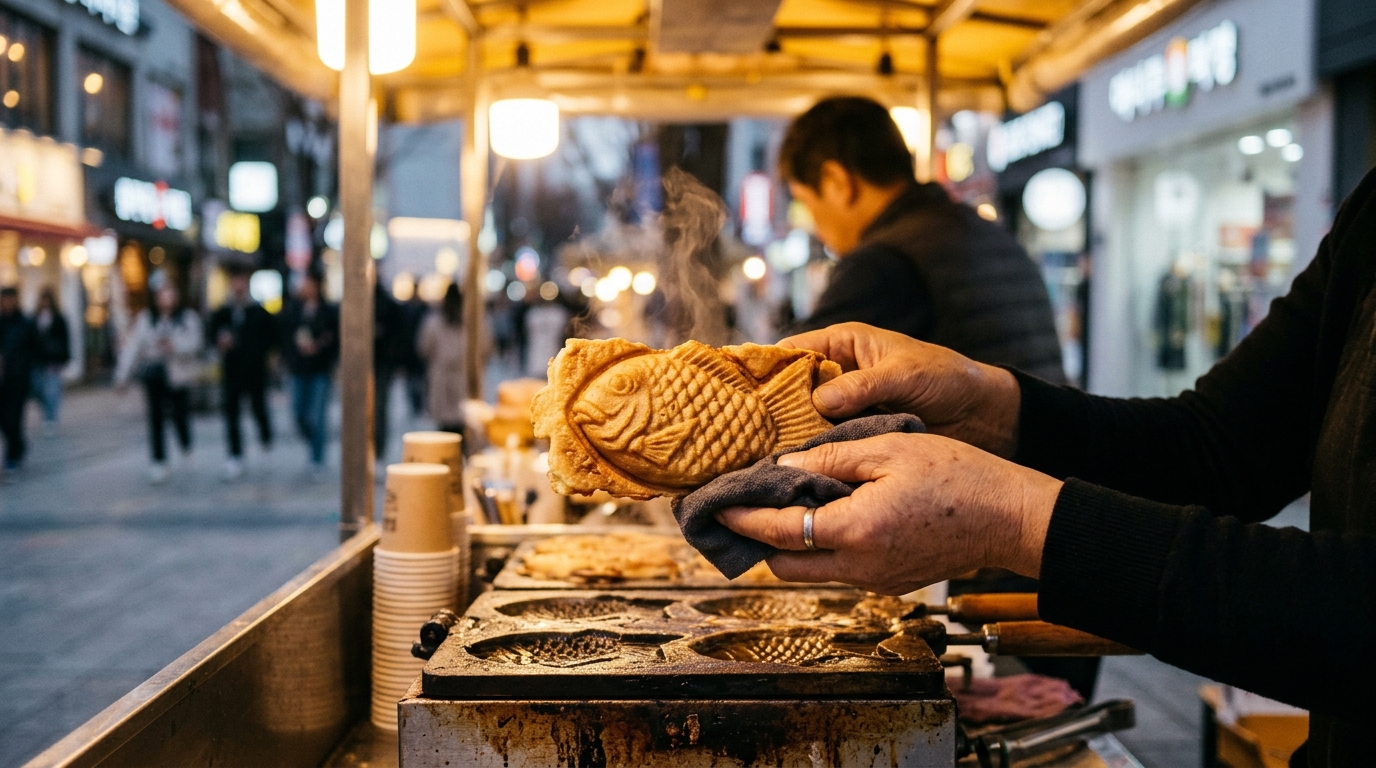
Bungeoppang is a fish-shaped waffle pastry poured from a hinged iron mold, traditionally filled with sweetened red bean paste. The classic recipe uses a wheat flour, cornstarch, and baking powder batter mixed to create a crisp outer crust and soft center. Sweet red bean remains the classic favorite, though custard cream (shukrim) serves as the top modern alternative, with select vendors offering cream cheese, nutella, or pizza toppings.
The snack originated in the 1930s as a local take on Japanese taiyaki. During post-war recovery in the 1950s and 1960s, wheat flour aid from the United States spurred street baking across Korean cities, establishing it as a winter staple. Economics have pushed prices up sharply in recent years: where vendors once sold three or four pastries for 1,000 KRW, standard 2026 pricing across residential Seoul sits at 1,000 KRW for a single pastry or 2,000 KRW for three. In high-rent hubs like Myeongdong or Gangnam, individual pastries run 2,000 KRW to 2,500 KRW.
Even with higher retail prices, street vendors operate on narrow margins. Operational financial records indicate that a cart generating 240,000 KRW in daily gross revenue by selling 240 pastries at 1,000 KRW each faces heavy deductions. After accounting for cart leases, LPG gas cylinders, paper packaging, batter mix, and red bean paste, net earnings can hover near minimum wage—often netting around 12,000 KRW per hour or less for physical labor in sub-zero weather.
Hotteok (호떡)
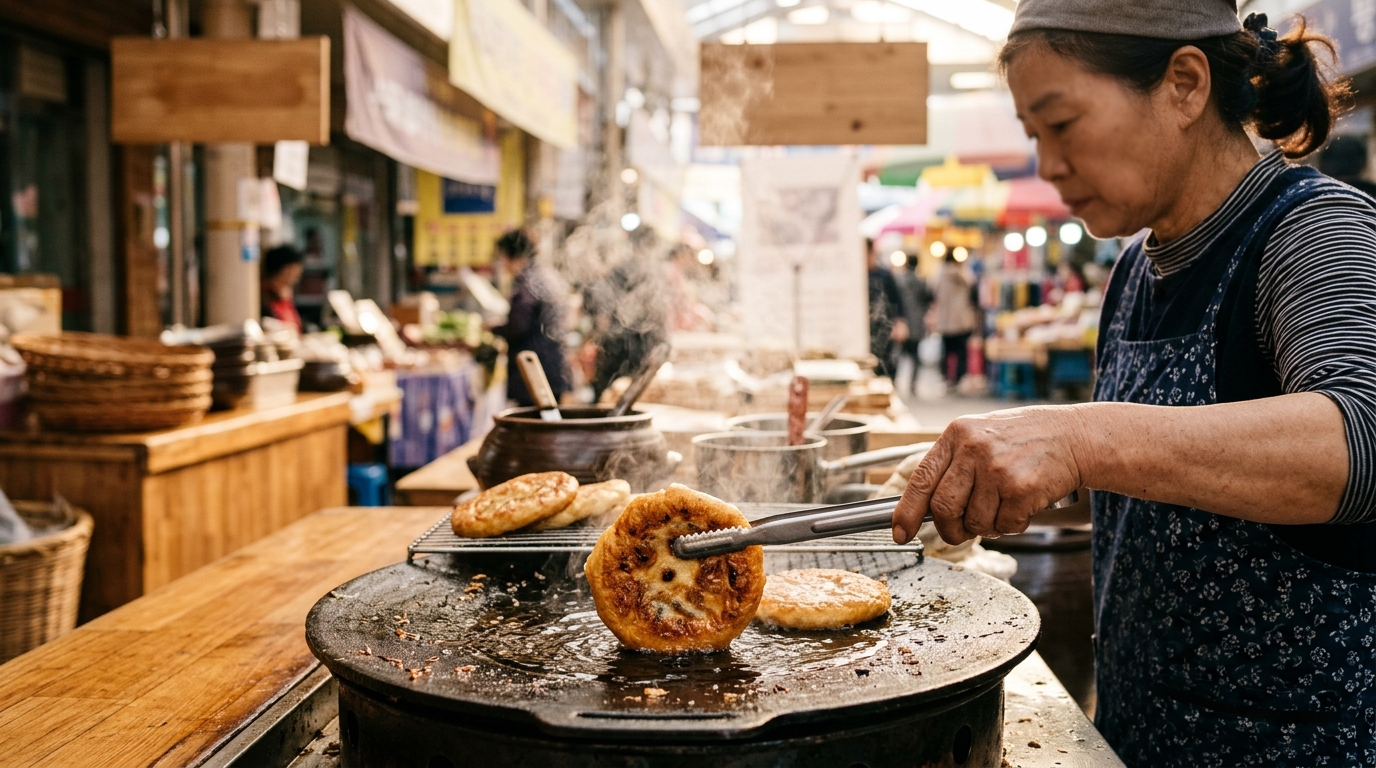
Hotteok is a pan-fried sweet pancake made from yeast-leavened flour and sticky rice dough. Vendors press ball-shaped dough onto a griddle brushed with oil or margarine, sealing in dark brown sugar, cinnamon, and chopped nuts like peanuts, sunflower seeds, or walnuts. Heat melts the interior into hot syrup. In coastal Busan, ssiat hotteok (씨앗호떡) is sliced open after frying and packed with toasted seeds.
Residential neighborhood stalls price hotteok between ₩1,500 and ₩2,000 per pancake, while high-footfall tourist zones charge ₩2,500 to ₩3,500. Vendors hand over each pancake folded in a paper cup or cardboard holder to shield hands from the heat. Allowing the hotteok to cool for 60 seconds before taking your first bite prevents painful syrup burns.
Gyeran-ppang (계란빵)
Gyeran-ppang is a steamed-and-baked bread loaf cooked with a whole egg inside or atop an oval mold of lightly sweet batter. Cast-iron electric baking units turn out warm loaves with a sweet-and-savory flavor profile. Variations add melted cheese, bacon, or parsley, making it one of the filling street options for breakfast or a quick snack.
Standard egg bread sells for ₩1,500 to ₩2,000 in local neighborhoods and reaches ₩2,500 to ₩3,000 in heavy tourist districts like Myeongdong. Containing a whole egg within a dense crust, it offers more protein and satiety per coin spent than lighter sugar pastries.
Eomuk Skewers (어묵)
Eomuk consists of processed fish paste blended with starch and seasoning, folded onto long bamboo skewers and simmered in steel tanks of broth cooked with dried anchovies, daikon radish, and kelp (dasima). Stalls offer free cups of hot drinking broth to standing patrons alongside the skewers. If you are comparing Seoul night market options, check out our Gwangjang Market vs Mangwon Market guide to plan your stop.
Fish cake skewers run ₩1,000 to ₩1,500 each at neighborhood carts, rising to ₩2,000 in busy commercial hubs. Carts display several formats, including flat folded ribbons, solid cylinders, and spicy chili-infused options.
Gun-goguma (군고구마)
Gun-goguma refers to sweet potatoes roasted in converted drum barrels or specialized thermal carts until their natural sugars caramelize into a soft, sweet interior. The aroma of roasted sweet potato skins in cold air remains a familiar winter marker in Korea.
A brown paper bag with two to three warm sweet potatoes costs ₩3,000 to ₩5,000 at local carts and ₩5,000 to ₩7,000 in tourist areas. Due to equipment costs and sidewalk spatial rules, drum-barrel vendors have become less common, making them a rarer sight on cold evenings.
Practical Money & Payment Guide: Why Cash is Still King for Tourists
Foreign tourists cannot use overseas Visa, Mastercard, or Apple Pay at non-stationary Korean winter street stalls. Temporary mobile carts operate under simplified registrations without electronic card readers or point-of-sale terminals. Physical Korean Won cash remains mandatory for purchasing snacks at mobile street food carts.
How to Prepare Payment for Street Vendors
- Withdraw Small Bills: Carry physical ₩1,000 and ₩5,000 banknotes. Passing a ₩50,000 bill to a street cart vendor for a ₩1,000 bungeoppang creates severe change-making strain on small stalls.
- Use Coin Allowance: Keep ₩500 coins handy in a dedicated coin purse, as winter street snack prices are rounded to exact ₩500 or ₩1,000 increments.
- Identify Permanent Kiosks: Fully structured brick-and-mortar storefronts or permanent subway station kiosks selling winter foods do accept physical credit cards and travel prepaid transport cards like T-money or WOWPASS.
For details on using international cards at public transit hubs, see our walkthrough on foreign card transit kiosks in Korea.
How to Find Moving Carts: Apps & Top Seoul Hotspots
Winter street stalls operate seasonally between November and early April. Because mobile vendors lack fixed commercial addresses, they do not appear on Google Maps or standard Naver Map searches. Finding active locations requires targeted tracking apps or visits to established market streets.
Most mobile vendors set up their iron molds and gas burners between 3:00 PM and 10:00 PM to serve afternoon commuters and evening crowds.
Top Seoul Neighborhoods for Winter Food Hunting
- Myeongdong Tourist Zone: Offers maximum variety with english-friendly signage, though prices reflect premium tourist markup (₩2,000–₩2,500 per item).
- Hongdae & Sinchon University Belts: High concentration of traditional, lower-cost carts (₩1,000 bungeoppang) catering to local college students.
- Gangnam Station Exits (Exits 10 & 11): Ideal for evening commuters seeking hot eomuk broth and gyeran-ppang.
- Traditional Markets (Gwangjang, Mangwon, Namdaemun): Permanent stall infrastructure open earlier in the day with stable pricing and indoor seat benches.
What Are the Essential Street Stall Hygiene & Transit Etiquette Rules?
Ordering street food in Korea goes smoothly when you follow standard customs regarding sauce application, broth usage, and public transit policies.
Condiment and Sauce Etiquette: The Double-Dipping Rule
Standing carts stock communal soy sauce or chili glaze jars with basting brushes on the counter. Double-dipping a bitten fish cake skewer directly into shared sauce containers is strictly prohibited for public hygiene reasons.
Standing Stalls vs. Walking Etiquette
At traditional carts, patrons usually finish their food right in front of the stall. This makes it easy to drop paper cups, wooden skewers, and wrappers directly into the vendor's trash bins. Walking down crowded streets holding sharp skewers or hot cups of broth can create safety hazards in dense pedestrian traffic.
Public Transit Food Rules in Seoul
Transit authorities enforce clear rules regarding food items across public networks:
Cultural Deep Dive: What 'Bungse-gwon' (붕세권) Says About Modern Korea
The slang term Bungse-gwon (붕세권) has become a popular phrase in everyday Korean conversation. Combining Bungeoppang with Yeokse-gwon (역세권, the real estate term for property near a subway station), the word describes a neighborhood with an active winter street food vendor nearby.
Its popularity highlights real shifts in urban Korea. Sidewalk regulations, redevelopment, higher retail rents, and rising ingredient costs have reduced the total number of informal carts. Consequently, having a reliable street vendor nearby is considered a cozy local advantage during cold months.
This relative scarcity has expanded the retail market for frozen grocery options. Major food companies now sell frozen bungeoppang designed for home air fryers at around ₩430 per piece, compared to ₩1,000 at street stalls. While home versions are convenient and cost less per unit, street stalls retain their appeal. Standing in the crisp winter air, smelling hot batter on iron molds, and sipping fish cake broth remains a distinct seasonal experience that packaged home versions do not duplicate.
Frequently asked questions
Q. Can I use my foreign credit card or Apple Pay at Korean street food stalls?
No, foreign credit cards, Visa, Mastercard, and Apple Pay are not accepted at mobile Korean street food carts. Independent vendors operate without electronic credit card terminals. You must pay using physical Korean Won cash, holding small ₩1,000 bills and ₩500 coins for smooth transactions.
Q. Why can't tourists use Korean mobile bank transfers (계좌이체) at street vendors?
Local mobile bank transfers via KakaoPay or Toss require a domestic South Korean bank account tied to an Alien Registration Card (ARC) and a Korean phone number. Standard international banking apps cannot process transfers to Korean street cart bank accounts scanned from on-cart posters.
Q. How do I find Bungeoppang stalls if they do not appear on Google Maps?
Street vendors do not have registered business addresses on Google Maps or Naver Map. Locate nearby operating carts by downloading the crowd-sourced app '3 Dollar in My Pocket' (가슴속 3천원), which pins active user-reported vendor locations, operating hours, and cash prices.
Q. Is the fish cake broth at Korean eomuk stalls free?
Yes, broth (*gukmul*) at eomuk stalls is free for paying food customers. Scoop broth into a paper cup using the ladle provided at the cart. Re-dipping your personal food skewer into communal sauce pots is strictly prohibited for hygiene reasons.
Q. Can I eat Korean street food while walking or take it onto Seoul buses?
Eating while walking is acceptable, though standing near the cart is preferred. Open food items, unsealed hot broth, and snacks on wooden skewers are strictly banned on Seoul city public buses. Subways permit sealed bags, but food must be eaten before boarding.