Seoul Salt Bread Bakeries: Top Spots, Prices & Queue Tips
Key takeaways
Seoul salt bread bakeries have popularized sogeum-ppang, a savory Korean roll with a caramelized, butter-fried bottom crust and a hollow butter cave. As of late 2026, premier spots like Jayeondo, Artist Bakery, Beton, and Soha Salt Pond offer purist and fusion varieties ranging from 3,500 KRW per roll to 12,000 KRW per 4-piece bundle. International visitors can register at CatchTable waiting kiosks or choose takeout lines to bypass long queues.
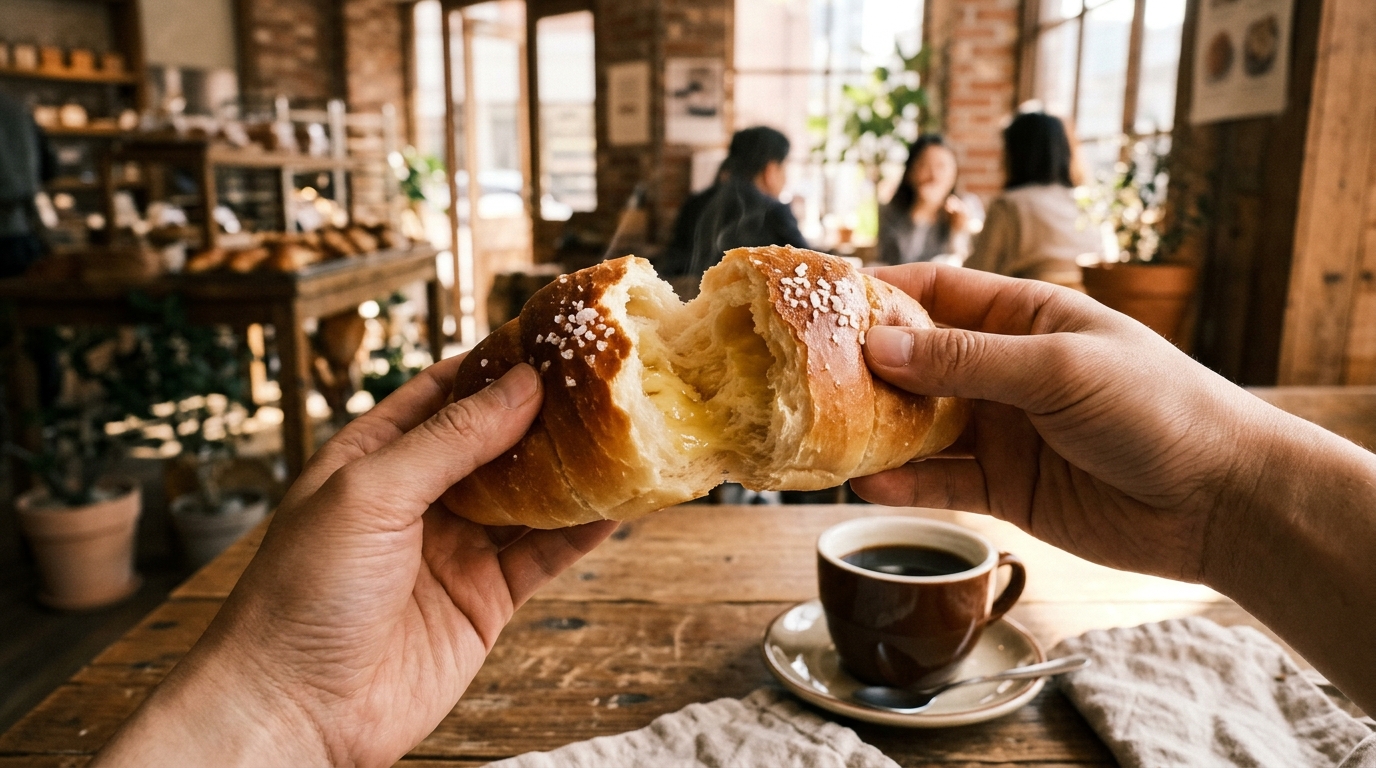
Getting a fresh, warm roll at seoul salt bread bakeries usually means timing your visit around bake schedules and registering at digital kiosks. Driven by viral videos of bakers tearing open warm rolls to show off hollow butter caves (beoteo donggul), morning lines at popular spots regularly pass the one-hour mark. Textures vary across neighborhood hubs, ranging from pillowy brioche dough to hard baguette crusts topped with sea salt flakes.
What Is Korean Salt Bread (Sogeum-ppang) and Why Is It Viral?
Korean salt bread, or sogeum-ppang (소금빵), is a rich, savory pastry adapted from Japanese shio pan (塩パン). While the original Japanese style keeps the butter profile light, Korean bakeries build a richer flavor. Bakers roll dough around a solid block of high-fat butter, such as French Échiré or New Zealand Anchor, shape it into a crescent, and sprinkle coarse sea salt like Korean Cheon-il-yeom (천일염) over the top.
High oven temperatures melt the core butter block into the surrounding dough during baking. This creates two distinct traits:
- The Butter Cave (Beoteo Donggul): Evaporating moisture inside the butter leaves a wide, hollow cavity through the center, making the inner crumb soft and moist.
- The Butter-Fried Bottom Crust: Melted butter runs out onto the baking sheet, frying the bottom into a crisp, caramelized crust.
Online interest took off as videos highlighted the sound of crackling crusts alongside steaming hollow centers. The trend also raised customer standards. Poorly made versions end up greasy when butter pools without absorbing, and with prices between 3,500 KRW and 4,800 KRW per piece at trend-focused cafes, visitors often compare flagship locations before joining a line.
How to Queue at Seoul Salt Bread Bakeries: CatchTable Kiosks & Phone Hacks
Most high-demand bakeries manage store entries through CatchTable (캐치테이블) kiosks. On busy weekend afternoons, waiting without registering early can mean standing outside for 60 to 90 minutes.
Visitors without a local Korean phone number (+82) can still use the digital waiting system through a few basic steps:
Selecting takeout instead of dine-in saves significant time. Bakeries package takeout orders rapidly as batches leave the oven. If you only want to sample the signature roll, select takeout on the tablet screen.
For additional step-by-step guidance on digital registers, review our guide on using a Korean kiosk with an English interface.
Top Seoul Salt Bread Bakeries: Comparison & Detailed Spots
Four main bakery brands lead the current salt bread scene in Seoul. The comparison below covers pricing, locations, and line rules as of late 2026.
| Bakery Name | Neighborhood | Signature Style | Price Range (KRW) | Queue System / Release Strategy |
|---|---|---|---|---|
| Jayeondo Salt Bread (자연도소금빵) | Myeongdong / Seongsu / Ikseondong | Soft, purist, butter-saturated classic roll | 12,000 KRW (Fixed 4-piece bundle) | 6 scheduled daily bake releases; on-site order kiosks |
| Artist Bakery (아티스트베이커리) | Anguk (Near Bukchon) | Dual textures (Soft Brioche vs. Hard Baguette) | 3,800 – 4,800 KRW per piece | On-site CatchTable opens at 07:30 AM; store opens 08:00 AM |
| Beton Seongsu (베통 성수) | Seongsu-dong | Round hobo-bag shape with dense, rich crumb | 3,900 – 4,500 KRW per piece | Hourly batch limits; in-person line & digital waiting list |
| Soha Salt Pond (소하염전) | Ikseondong | Creative fusion toppings & salt-flat aesthetic | 3,500 – 4,800 KRW per piece | Continuous baking; separate takeout register |
Jayeondo Salt Bread (자연도소금빵) – The Purist 4-Piece Bundle Standard
Jayeondo focuses exclusively on one item: classic salt bread sold in 4-piece paper bundles tied with string. With storefronts in Seongsu-dong, Myeongdong, and Ikseondong Hanok Village, the shop runs high-volume production tied to strict oven schedules.
Warm rolls come out across six set bake release times each day:
- 09:00 AM
- 12:30 PM
- 02:00 PM
- 03:30 PM
- 05:00 PM
- 06:30 PM
Jayeondo exclusively uses Canadian wheat, French Échiré butter, and sun-dried Korean sea salt to achieve a roll that melts into a savory butter pooling at the base. Rolls are sold only as a 4-pack bundle for 12,000 KRW. Selling fixed bundles keeps the register line moving quickly while ensuring batches stay warm.
Artist Bakery Anguk (아티스트베이커리) – Soft vs. Hard Crust Variety
Located outside Anguk Station Exit 1, Artist Bakery is operated by the team behind London Bagel Museum. Rather than serving one standard texture, the menu separates classic rolls into two crust options:
- Soft Salt Bread (Syo-beu): Soft brioche dough with a tender crust.
- Hard Salt Bread (Hadeu): Lean baguette dough with a crackling crust that limits grease absorption.
They also serve garlic butter, truffle, sesame, and pretzel versions. CatchTable kiosk sign-ups open at 07:30 AM, half an hour before the 08:00 AM store opening. Dine-in seating routinely reaches wait times over 90 minutes during peak midday hours, whereas takeout lines clear much faster.
Beton Seongsu (베통 성수) – The Hobo-Bag Round Shape Pioneer
Beton in Seongsu-dong shapes its dough into an asymmetrical round loop resembling a hobo bag. The bakery opens daily from 09:00 AM to 18:30 PM and caps hourly production batches to maintain consistency.
The rounded loop shape helps prevent butter from escaping during proofing, retaining more melted fat inside the cavity during baking. This gives the bread a dense crumb and caramelized base. If you plan to shop nearby, check our guide to Seongsu-dong pop-up store waiting strategies.
Soha Salt Pond (소하염전) – Creative Fusion Flavors
Designed like a traditional Korean salt farm with wooden watermills and salt mounds, Soha Salt Pond in Ikseondong focuses on sweet and savory menu variations. Options alongside classic rolls include:
- Truffle Salt Bread: Finished with black summer truffle salt.
- Salted Peanut Cream Bread: Filled with cold roasted peanut cream and sea salt.
- Cheese & Spring Onion Salt Roll: Layered with scallion butter and melted cheddar.
Bakery Selection Rules: Matching Your Taste & Schedule
Match your destination to your schedule and preferred texture to avoid unnecessary waiting.
Travel Logistics, Payment Rules, and Reheating Methods
Keep these practical store rules and travel guidelines in mind when visiting bakeries in Seoul.
Payment Rules and Kiosks
Nearly all modern salt bread shops in Seoul operate card-only payment self-service ordering terminals. Kiosks accept major foreign credit cards including Visa and Mastercard, but high-volume ordering windows generally do not accept cash. To set up transit and store payments on one card, read our WOWPASS foreign card guide.
Cafe Seating Etiquette
Korean bakery cafes strictly enforce a "One Drink per Person" (1인 1음료) policy for dine-in tables. Buying pastries alone does not grant access to seating; every adult guest in your group must order an individual drink.
Flight Customs and Dietary Considerations
Review these facts if you plan to carry rolls onto flights or have dietary requirements:
- Taking Salt Bread on Flights: Aviation security rules permit baked bread through airport security checkpoints in carry-on and checked luggage because it is classified as dry solid food. Pack rolls in sealed containers within 24 hours of departure to prevent them from losing moisture.
- Dietary Aspects: Korean salt bread is lacto-vegetarian as it contains milk and butter, but it is not vegan. Standard rolls contain gluten from wheat flour.
Reheating Takeout Salt Bread
As salt bread cools, melted butter absorbs back into the flour. Eating cold rolls hours after purchase can feel heavy. Use these methods to restore the original texture:
Practical Visitor Summary
Frequently asked questions
Q. What makes Korean salt bread different from regular butter rolls or croissants?
Korean salt bread (sogeum-ppang) wraps dough around a solid block of butter that melts during high-heat baking. This process creates a hollow center called a butter cave and fries the bottom of the roll into a caramelized, crispy crust, topped with coarse sea salt.
Q. Can foreign tourists without a Korean phone number line up at CatchTable kiosks?
Yes, foreign tourists can queue at CatchTable kiosks by installing the CatchTable Global mobile app using an email address. Alternatively, visitors can request store staff at the front entrance to register their entry manually using an international number.
Q. Why do some bakeries in Seoul like Jayeondo only sell salt bread in 4-piece bundles?
Bakeries like Jayeondo operate high-volume production models to ensure maximum freshness across set daily release schedules. Selling fixed 4-piece bundles (12,000 KRW as of late 2026) speeds up purchasing lines and keeps rolls warm straight from the oven.
Q. Are foreign credit cards accepted at self-service kiosks in Seoul bakeries?
Yes, automated ordering kiosks at major Seoul salt bread bakeries widely accept foreign Visa and Mastercard credit cards. However, these ordering stations are generally cashless, so cash payment is usually not accepted.
Q. How should I reheat takeout salt bread to make it crispy again?
The most effective method to reheat salt bread is in an air fryer at 160°C (320°F) for 2 to 3 minutes. Alternatively, toast the roll on a dry skillet over low heat for 1 to 2 minutes so the bottom crust re-fries in its own butter.