Korean Banchan Self Service Etiquette: Refill Rules
Key takeaways
Korean banchan self service etiquette balances generous free side dish refills with clear boundaries against waste and misuse. While basic vegetable dishes like kimchi are standard unlimited free refills, premium items like marinated crab cost 5,000 to 10,000 KRW extra. As of February 2026, 38.5% of Korean restaurant owners favored charging for side dish refills amid rising ingredient costs, making proper self-bar etiquette essential for foreign diners.
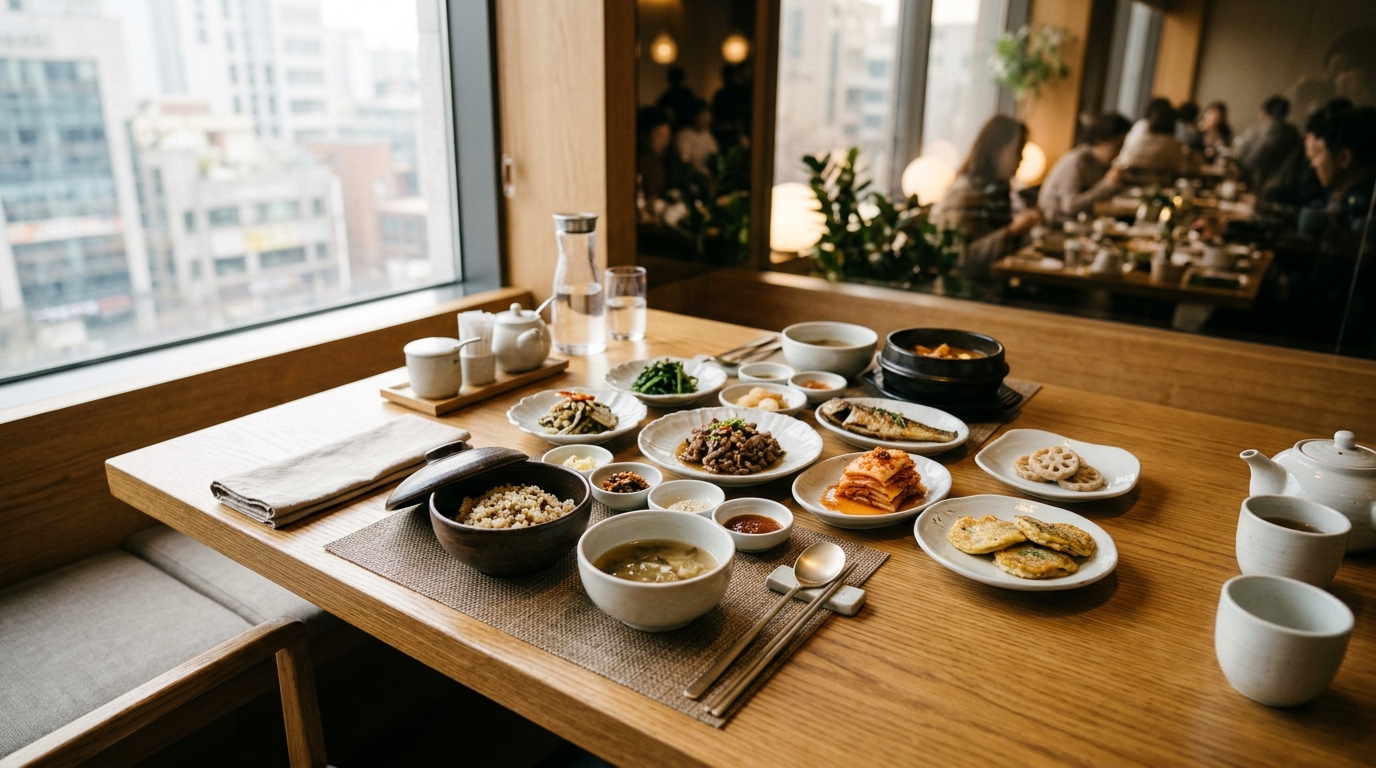
Practicing proper Korean banchan self service etiquette keeps your meal smooth and respects local dining norms. In South Korea, traditional meals center on hansang-charim (한상차림), where individual rice and soup bowls arrive alongside shared side dishes called banchan (반찬). Most basic vegetable sides remain free of charge, but rising ingredient costs and the shift toward self-service stations mean diners need to know the rules, etiquette boundaries, and potential extra fees.
This guide breaks down how to spot self-service stations, which side dishes cost extra, how food waste fee warnings work under South Korean law, and the polite Korean phrases to request extra portions gracefully.
Table Service vs. Self-Service Bars: How to Spot the Refill System
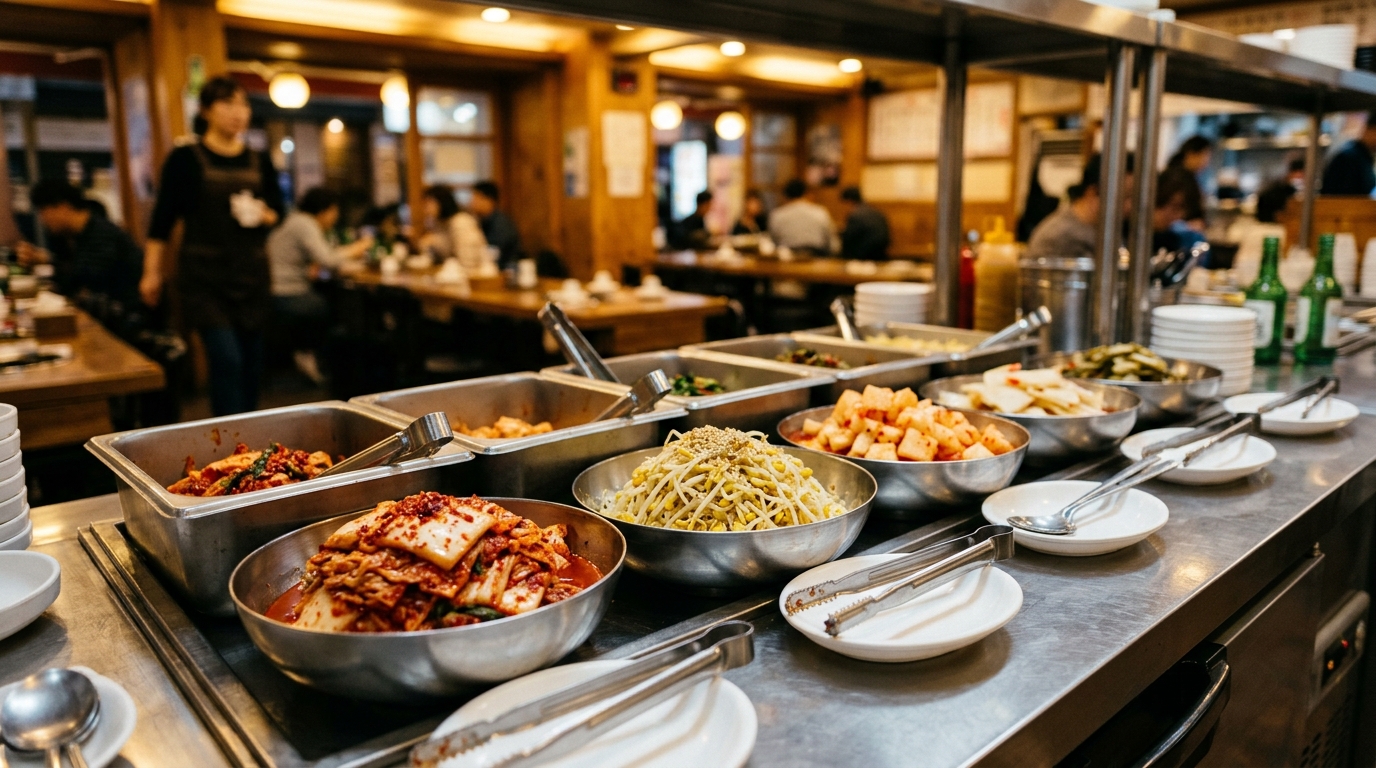
Korean eateries use two main refill setups: staff table service or a central self-service bar. Spotting which system a venue uses saves time and avoids awkward moments.
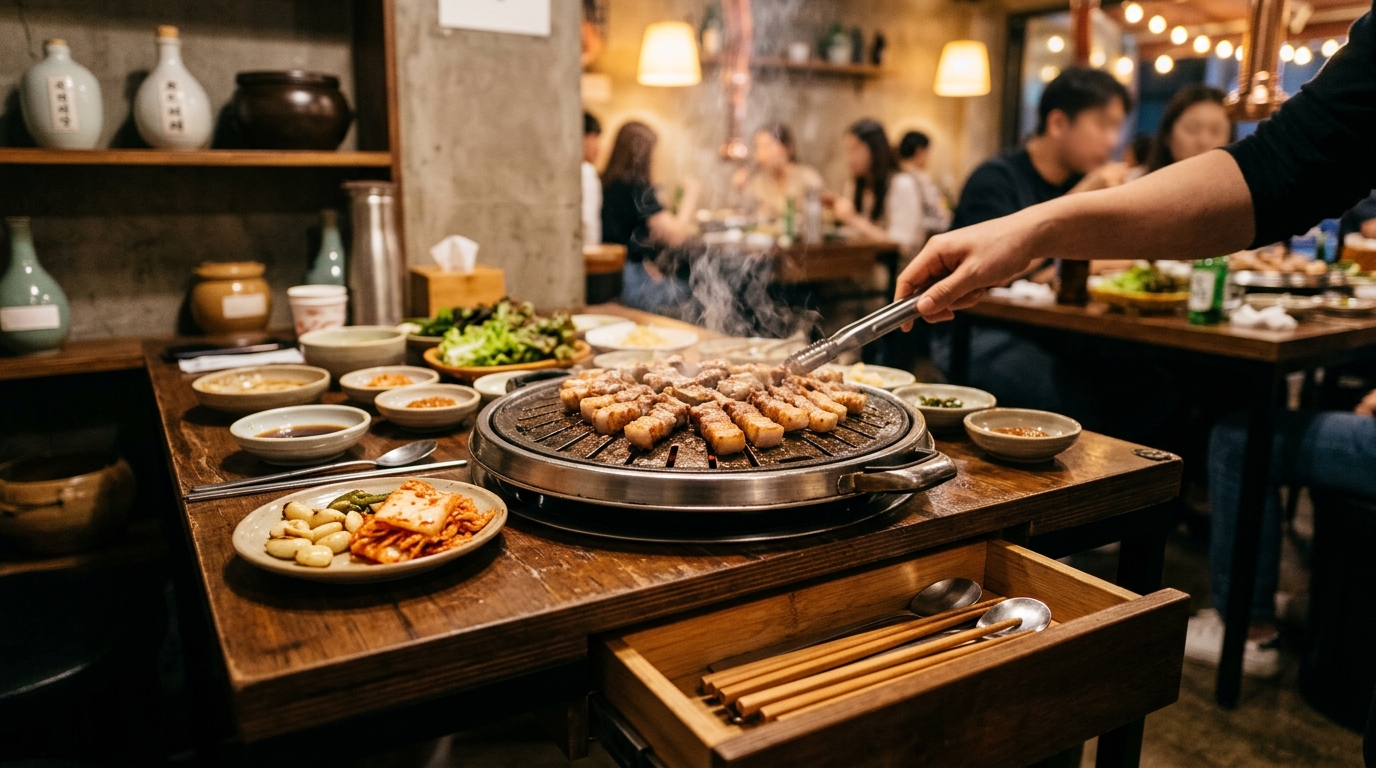
At table-service places, staff bring small saucers directly to your table when serving the meal. When a saucer empties, you ask the server for a refill. Self-service places operate differently, featuring a buffet-style station where guests get up to grab their own refills from communal containers.
Common signs posted in Korean dining rooms help clarify what guests should do:
| Korean Sign Phrase | Romanization | English Meaning | Action Required |
|---|---|---|---|
| 추가 반찬은 셀프입니다 | Chuga banchan-eun selpeu-imnida | Additional side dishes are self-service | Fetch your own refills from the self-bar |
| 물은 셀프입니다 | Mureun selpeu-imnida | Water is self-service | Retrieve water cups and bottles from the cooler |
| 반찬은 드실 만큼만 | Banchan-eun deosil mankeum-man | Take only as much as you will eat | Take small portions to prevent food waste |
| 추가 반찬 주문 | Chuga banchan jumun | Additional side dishes require ordering | Order premium side dishes through staff or kiosk |
Fast-casual diners—such as gimbap shops, soup houses (gukbap), and Korean barbecue spots—almost always run self-service bars. If you are unsure upon walking in, glance around to see whether other guests are walking to a central buffet counter with small white saucers.
Free Refills vs. Extra Fees: Which Side Dishes Cost Extra Money?
Free side dish refills are a hallmark of Korean dining, but not every bowl comes with unlimited top-offs. The boundary generally sits between basic vegetable side dishes and labor-intensive protein mains.
Everyday vegetables—napa cabbage kimchi (baechu-kimchi), seasoned bean sprouts (kongnamul-muchim), pickled radish (danmuji), raw garlic, sliced chilis, and soybean paste (ssamjang)—remain free and unlimited nearly everywhere. Protein-rich items and main-dish supplements usually carry separate menu prices.
An online poll of 1,353 South Korean restaurant owners conducted in February 2026 on the self-employed business community "아프니까 사장이다" found that 38.5% of operators favored introducing fees for side dish refills due to agricultural inflation, while 61.5% opposed charging out of concern for customer reactions. While basic kimchi stays free at most diners, barbecue houses and seafood specialty venues increasingly set strict rules or extra fees for premium items.
| Banchan Category | Example Items | Refill Policy | Typical Extra Fee |
|---|---|---|---|
| Standard Vegetables | Kimchi, bean sprouts, pickled radish, lettuce, garlic | Free & Unlimited | 0 KRW |
| Egg Dishes | Steamed egg (gyeran-jjim), rolled omelet (gyeran-mari) | Varies by shop | Free initial serving; 2,000–4,000 KRW for extra |
| Premium Proteins | Raw marinated crab (ganjang-gejang), boiled pork (bossam) slices | Strict Fee | 5,000–10,000 KRW per plate |
| Fresh Seafood / Pancakes | Seasoned raw squid, seafood pancake (해물파전) | Paid Refill | 3,000–7,000 KRW |
When a side dish has a price listed beside it on the menu, staff will decline free refill requests. Checking the menu or kiosk screen first prevents misunderstandings.
Step-by-Step Self-Service Bar Etiquette & Rules
Using a Korean self-service bar involves standard hygiene etiquette designed to keep food fresh for everyone.
Taking excess food home in personal plastic containers or bags from a self-service station is strictly forbidden in Korean dining culture. South Korean news outlets occasionally cover incidents where patrons brought personal containers to fill up at self-service bars, resulting in public criticism and restaurant bans for disruptive behavior (jinsang).
The Environmental Waste Fee: Is the Warning Fine Legally Enforced?
Self-service bars frequently display warnings about an environmental waste fee (hwan-gyeong budam-geum, 환경부담금)—usually 2,000 KRW to 5,000 KRW—for leaving food unconsumed.
Under South Korea's Environmental Improvement Cost Act, the government imposes no statutory fines directly on individual restaurant diners for leaving food on their plates. These signs reflect house rules set by business owners to discourage wasteful habits.
In practice, restaurant staff rarely charge the 2,000 KRW fee for minor scraps. However, if a table leaves full, untouched saucers stacked high from the self-bar, management reserves the right to add the fee to the final bill. Take small portions to show respect for the kitchen and keep your checkout straightforward.
Re-Serving Leftovers and Food Safety Regulations
Visitors sometimes question whether untouched side dishes returned to kitchen areas might be re-served. South Korean health laws set clear regulations on banchan handling.
Establishments caught reusing side dishes face administrative penalties, including business suspensions from 15 days to several months, or license revocation. Strict exceptions exist only for items like unpeeled whole garlic cloves, undamaged raw lettuce leaves that are thoroughly re-washed, or unopened factory-sealed condiment packets.
Because of these rules, any side dish transferred to your personal plate must be discarded by the restaurant if left unconsumed. Taking smaller servings prevents good food from being thrown away.
Essential Korean Phrases: How to Ask for Refills Gracefully
In table-service venues without a self-bar, asking staff for refills using polite Korean speech (jondeatmal) ensures a smooth interaction.
Key phrases for polite refill requests:
-
"여기 반찬 좀 더 주세요." Yeogi banchan jom deo juseyo. ("Please give us a little more side dishes here.")
-
"김치 더 주세요." Kimchi deo juseyo. ("Please give us more kimchi.")
-
"이거 좀 더 주실 수 있나요?" Igeo jom deo jusil su itnayo? ("Could you please give us a bit more of this one?") — Point politely to the specific empty saucer.
-
"감사합니다." Gamsahamnida. ("Thank you.")
When ordering at the table, specify which dish you want refilled rather than asking servers to bring back every dish on the table. If you only want pickled radish, point to that saucer so staff don't waste extra food.
Solo Diners & Payment Logistics: Navigating Korean Restaurants
Solo dining in South Korea—known as honbap (혼밥)—is widely accepted, though self-service refills take a little practical coordination when dining alone.
Self-Service Bars for Solo Diners
When eating alone, leave a personal item (a jacket, umbrella, or water glass) at your seat when getting up for banchan refills. This lets waitstaff and incoming guests know the table is taken.
Digital Ordering Kiosks
Many modern Korean restaurants use touchscreen kiosks at the entrance or tabletop digital screens. When using a screen for refills:
- Select the tab labeled "반찬/추가" (Banchan/Chuga - Side Dishes/Additions).
- Basic refills like kimchi or broth often list at 0 KRW; tap to add the request.
- Paid side dishes (extra meat, fried eggs, or dumplings) display their price in South Korean Won (KRW).
Tipping and Payment Etiquette
Tipping is strictly 0 KRW across South Korea in all traditional restaurants, cafes, and self-service eateries. Leaving cash on the table or counter is unnecessary and confuses the staff.
Payment happens at the cash counter near the exit or directly on the tabletop ordering screen. Major international credit cards (Visa, Mastercard, American Express) and prepaid travel cards like WOWPASS, NAMANE, and T-money are accepted at standard dining spots.
Following these simple norms lets you enjoy Korea's side-dish tradition smoothly while respecting local businesses. Planning a trip around Seoul? Learn how to navigate public transit effortlessly with our practical guide to buying and topping up T-money cards.
Frequently asked questions
Q. Is banchan always free and unlimited in Korean restaurants?
Basic vegetable banchan like kimchi, bean sprouts, and pickled radish are generally free and unlimited. However, protein-rich items such as raw marinated crab (ganjang-gejang) or savory seafood pancakes (jeon) cost between 3,000 KRW and 10,000 KRW extra per additional portion.
Q. Do Korean restaurants actually charge the 2,000 KRW environmental waste fee?
Environmental waste fees (환경부담금) ranging from 2,000 to 5,000 KRW serve primarily as psychological deterrents against excessive food waste. Under South Korea's Environmental Improvement Cost Act, these fees carry no statutory legal backing, though individual restaurant owners reserve the right to enforce house policies.
Q. Can I pack leftover self-bar banchan into a container to take home?
No, bringing external plastic containers to take self-bar banchan home is strictly taboo in Korean dining etiquette. Taking banchan off the premises violates basic restaurant policies and often triggers public outrage or extra charges from staff.
Q. How do I know if a Korean restaurant uses self-service for banchan refills?
Look for signs reading "추가 반찬은 셀프입니다" (Additional banchan is self-service) near communal food stations. If no self-service bar is visible, waitstaff will handle all refills directly at your table when asked politely.
Q. Is it safe to eat banchan, or do restaurants reuse leftover side dishes?
Under the June 2009 revision of South Korea's Food Sanitation Act Enforcement Rules, re-serving leftover banchan to other customers is strictly illegal. Professional restaurants discard all unconsumed side dishes left on dining tables immediately after guests depart.