Korean Convenience Store Iced Cup Drinks: Local Guide
Key takeaways
Korean convenience store iced cup drinks pair packaged ice cups with drink pouches to deliver affordable, customizable beverages. This guide covers step-by-step preparation, cup sizing ratios to avoid spills, payment options with foreign cards or T-money, viral local drink mixes, and store recycling etiquette.
What Is the Korean Convenience Store Ice Cup Trend?
Korean convenience store iced cup drinks pair pre-packaged ice cups with plastic beverage pouches, offering a fast, low-cost drink option across South Korea. Known locally as eoreum-cup (얼음컵) and pouch-eumryo (파우치 음료), this quick-serve setup has turned everyday corner stores into customizable self-serve drink spots.
Instead of self-serve fountain machines, local convenience stores stock chest freezers with sealed plastic cups of purified ice right beside display racks of coffee, tea, juice, and mixer pouches. Data from BGF Retail indicates that over 90% of customers buying a drink pouch pick up a matching ice cup at the same time. BGF Retail's CU store network reports selling over 150 million pouch drink units every year, showing how deeply this habit fits into daily routines in South Korea.
A few practical factors drive the system's popularity: low prices, wide variety, and a strong local culture around cold beverages. South Koreans frequently talk about the eol-juk-ah (얼죽아) mindset, an acronym meaning "even if I freeze to death, iced Americano." Convenience stores satisfy this year-round demand with an option that costs far less than traditional coffee shops. While a standard cafe iced latte in Seoul runs between 4,500 KRW and 7,000 KRW ($3.30–$5.20 USD), a pouch-and-ice combination costs between 1,800 KRW and 3,800 KRW ($1.30–$2.80 USD). Travel insights on Looxk Korean Lifestyle Guide show how this price difference offers an affordable quality choice for both local office workers and visiting travelers.
How Do You Make Your First Ice Cup Drink Step-by-Step?
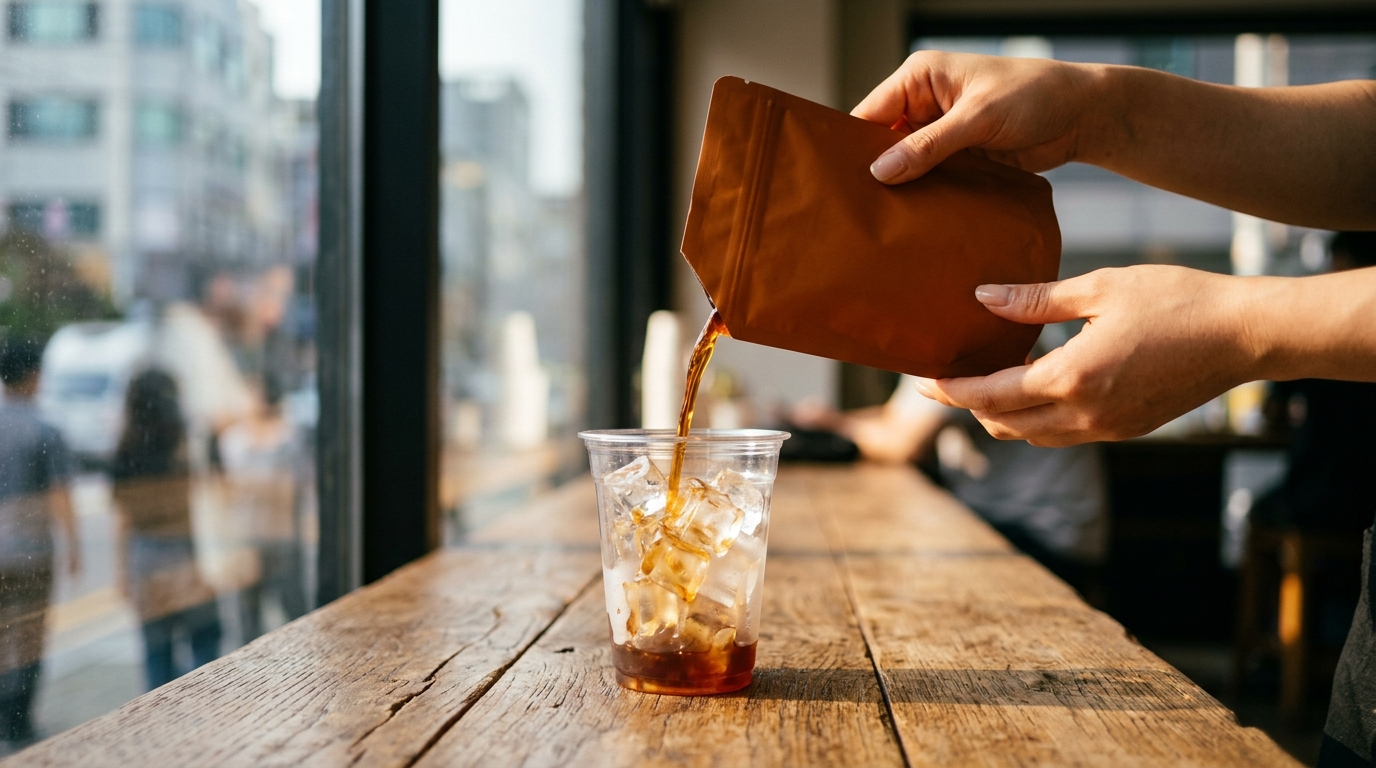
Making an iced pouch drink takes four basic steps: grab a cup from the freezer chest, pick your beverage pouch, pay for both items at checkout, and pour the liquid over the ice yourself. The full process takes under two minutes from store entry to first sip.
The most important rule for beginners is paying for both the ice cup and pouch at the counter before peeling open the lid or pouring the drink. Store counters keep straw containers stocked with both standard straws and wider options designed for bubble teas or thicker smoothie pouches.
What Ice Cup Size Matches Your Beverage Volume to Prevent Overflows?
Selecting the right cup depends on liquid pouch volume and solid ice displacement, meaning a standard 190 mL drink fits a Medium cup, while 340 mL pouches or double-pouch mixes call for Large or Extra-Large cups.
Picking a cup that is too small leaves extra liquid in the pouch, while choosing a cup that is too large dilutes your beverage as excess ice melts over time. Convenience store chains offer standardized cups filled with clear ice cubes, slow-melting ice spheres, or crushed ice.
| Cup Size | Ice Weight | Ideal Pouch Volume | Average Price (KRW) | Best Used For |
|---|---|---|---|---|
| Regular / Medium | 180g – 190g | 190 mL – 230 mL | 800 KRW | Standard Americano, single espresso shot, hazelnut coffee |
| Large | 230g – 250g | 250 mL – 330 mL | 1,000 KRW | Big-size iced coffees, fruit teas, single pouch + soda splash |
| Extra-Large / Jumbo | 340g – 400g | 340 mL – 500 mL | 1,200 – 1,500 KRW | Double pouch combinations, 500 mL energy drink mixes |
| Sphere Ice Cup | 130g – 160g | 150 mL – 200 mL | 1,500 – 2,000 KRW | High-end cold brews, whiskey shots, premium fruit concentrates |
Note: Pricing figures reflect nationwide average pricing as of mid-2026 across major convenience chains following standard industry updates.
How Do Foreign Credit Cards, Apple Pay, and T-Money Work at Checkout?
Paying at Korean convenience store counters is fast and simple for visitors, as terminals accept international credit cards, contactless mobile systems like Apple Pay, local transit cards such as T-money, tourist prepaid cards, and cash in South Korean Won (KRW).
Major foreign credit cards—including Visa, Mastercard, AMEX, and JCB—are accepted at virtually all convenience store locations in South Korea. POS card terminals include IC chip card slots on the bottom or side and contactless readers on top. Contactless payments via Apple Pay work seamlessly across major convenience chains provided your foreign credit card supports international contactless transactions.
| Payment Method | Accepted Chains | Minimum Purchase | Special Requirements / Notes |
|---|---|---|---|
| Foreign Credit Card (Visa/MC) | All Chains | None | Must insert IC chip into bottom slot if contactless fails |
| Apple Pay | CU, GS25, 7-Eleven, Emart24 | None | Requires foreign Visa or Mastercard linked to Apple Wallet |
| T-money / Cashbee | All Chains | None | Must be reloaded with physical KRW cash at counter or station |
| WOWPASS / NAMANE Card | All Chains | None | Acts as a prepaid local card + transit pass for tourists |
| Cash (KRW) | All Chains | None | Cashiers accept precise or large notes; change returned in KRW |
For readers using T-money or WOWPASS cards, card balances display directly on the customer screen during payment. When a card balance runs low, give cash to the cashier, tap the card on the reader pad, and say "Chung-jeon hae-ju-se-yo" (Please reload this card).
What Are the Top 5 Viral Local Drink Combos to Try?
Popular custom drink recipes combine store-bought coffee pouches, carbonated soft drinks, boxed dairy products, and Korean energy tonics into visual layers and distinct flavor profiles.
As explained in beverage guides on Easy Korea Travel Guide, mixing individual items lets customers try distinct South Korean flavor pairings favored by students and workers.
1. The Eolbaksa (얼박사)
- Ingredients: Bacchus-F (박카스) energy drink + Chilsung Cider (칠성사이다) or sparkling water + Large Ice Cup.
- Taste Profile: Sweet, citrusy, and bubbly with a distinct stamina-drink kick.
- Background: Originally invented in Korean public saunas (jjimjilbang, 찜질방) to replenish electrolytes, this blend became so popular that retail chain GS25 launched an official pre-mixed RTD version of Eolbaksa that sold over 2.5 million units within two months of release.
2. Ah-Sat-Chu / Iced Peach Tea with Espresso (아샷추)
- Ingredients: Iced Peach Tea pouch + 1 Shot of pouch Black Coffee/Espresso + Medium Ice Cup.
- Taste Profile: Starts with intense floral peach sweetness and finishes with bitter dark roasted espresso.
- Background: Short for I-sue-tee-e Shot Choo-ga (iced tea with an espresso shot added), this combination became a nationwide staple across Korean cafes and convenience store DIY stations.
3. Banana Milk Espresso Latte (바나나우유 라떼)
- Ingredients: Binggrae Banana Flavored Milk (바나나맛 우유) + Dark Espresso or Black Coffee pouch + Extra-Large Ice Cup.
- Taste Profile: Creamy, rich, and sweet banana milk offset by strong espresso coffee notes.
- Assembly Tip: Pour the banana milk into the ice cup first, then slowly pour the black coffee pouch directly over the top to create a two-toned gradient layer.
4. Blue Lemonade Sparkling Milkis (청량 블루밀키스)
- Ingredients: Blue Lemonade pouch + Milkis (밀키스) creamy carbonated soda + Large Ice Cup.
- Taste Profile: Tangy citrus lemon paired with smooth, milky carbonation.
- Visual Effect: Creates an electric cyan blue color gradient, making it one of the most photographable drinks on social media.
5. Hazelnut Mocha Velvet (헤이즐넛 초코)
- Ingredients: Sweet Hazelnut Coffee pouch + Chocolate Milk carton (or Cacao pouch) + Large Ice Cup.
- Taste Profile: A rich, nutty moccaccino drink reminiscent of iced cafe specialties at a fraction of the cost.
How Do CU, GS25, 7-Eleven, and Emart24 Differ for Drink Lovers?
Korean convenience store chains stand out through proprietary pouch beverage brands, unique flavor collaborations, and varied price promotions.
As beverage roundups on Jingoo Kim's Travel Notes show, convenience chains update their pouch lines each season with zero-sugar choices, specialty tea blends, and branded coffee releases.
| Convenience Store Chain | Exclusive Pouch Line | Key Strengths & Specialty Drinks | Value Promotions |
|---|---|---|---|
| CU (BGF Retail) | Delaffe (델라페) | Biggest overall pouch selection; wide variety of zero-sugar teas, fruit pouches, and decaf coffee | Frequent 2+1 pouch bundle deals during summer months |
| GS25 (GS Retail) | Cafe25 / YouUs (유어스) | Pioneer of viral collaborations (official Eolbaksa RTD); high-grade pouch cold brews | Year-round fixed-price pouch coffee + free ice cup promotions |
| 7-Eleven | Seven Select | Focuses on premium coffee roasted bean pouch blends and Japanese snack tie-ins | Combo discounts when buying pouch drinks with baked pastries |
| Emart24 | I'm e (아임이) | Budget-focused, unique fruit nectar mixes, and artisan tea blends | Lowest standalone ice cup pricing and discount multi-buys |
GS25, for example, offers a year-round promotion combining select pouch coffees with a free Medium ice cup for roughly 1,000 KRW. Meanwhile, CU’s proprietary Delaffe line prints clear nutrition labels that spotlight zero-sugar and low-calorie options.
What Is Visitor Etiquette for Waste Sorting and Useful Korean Checkout Phrases?
Proper etiquette at Korean convenience stores comes down to two steps: sorting beverage packaging into designated recycling bins and using basic polite Korean expressions with staff.
South Korea enforces strict recycling regulations (boun-ri-su-geo, 분리수거). Stores maintain multi-compartment recycling stations near entrances or outdoor seats, and customers drinking on site are expected to sort trash properly.
When buying drinks at the counter, a few quick Korean phrases ensure a smooth transaction.
| English Meaning | Korean (Hangul) | Romanization / Pronunciation | Context / When to Use |
|---|---|---|---|
| Hello | 안녕하세요 | An-nyeong-ha-se-yo | Greeting the clerk upon entering or approaching the counter |
| An ice cup, please. | 얼음컵 주세요 | Eo-reum-cup ju-se-yo | Asking the clerk if ice cups are kept behind the counter |
| Please charge my T-money card. | 교통카드 충전해주세요 | Gyo-tong-card chung-jeon-hae-ju-se-yo | Handing cash to reload a transit card at checkout |
| I don't need a bag. | 봉투는 안 주셔도 돼요 | Bong-tu-neun an ju-shyeo-do dwae-yo | Declining a plastic shopping bag (which costs 20–100 KRW) |
| Thank you! | 감사합니다 | Gam-sa-ham-ni-da | Polite sign-off when receiving your receipt or leaving the store |
Frequently asked questions
Q. Why do Korean convenience stores sell packaged ice cups instead of using fountain machines?
Sealed ice cups maintain high standards of hygiene, prevent contamination, allow precise temperature control, and make drink assembly mobile and portable for daily commuters.
Q. Can tourists use foreign credit cards or Apple Pay to buy convenience store drinks?
Yes, foreign Visa, Mastercard, AMEX, and foreign credit cards linked to Apple Pay are accepted across major Korean convenience store chains like CU, GS25, 7-Eleven, and Emart24.
Q. Are convenience stores in Korea open 24/7?
The vast majority of convenience stores in South Korean cities operate 24 hours a day, 7 days a week, making ice cups accessible at any time.
Q. Are zero-sugar or decaf pouch options available?
Yes, major convenience store lines like CU's Delaffe and GS25's YouUs offer extensive zero-sugar fruit teas, low-calorie ade mixes, and decaffeinated coffee pouches.
Q. Can visitors sit and drink inside the convenience store?
Most Korean convenience stores feature high counters, window seating, or outdoor tables specifically provided for customers who purchase food and beverages on site.