Korean Convenience Store Hot Food: 7 Winter Snacks to Try
Key takeaways
Korean convenience store hot food provides accessible winter dining across chains such as GS25, CU, and Seven-Eleven. Individual hot snacks range from ₩1,000 to ₩3,500 ($0.75–$2.60 USD as of October 2026), featuring steamed buns, skewered fish cakes with warm broth, and stone-roasted sweet potatoes.
Korean Convenience Store Hot Food becomes essential when winter temperature dips across South Korea, as neighborhood convenience stores double as accessible warming stations stocked with hot meals. Industry figures from October 2026 highlight this shift clearly: franchise operator GS25 recorded a 667% jump in instant fish cake sales during early cold snaps. As traditional outdoor street carts (pojangmacha, 포장마차) become scarcer due to urban rezoning, 24-hour retail chains now handle most of the country's quick winter comfort food demand. Millions of viewers tune into online taste-test videos showing how these storefronts serve quick, affordable heat. Getting a hot meal inside requires no Korean language skills once you know how the stations operate.
Why Is Winter Convenience Store Hopping a Must-Do Experience in Korea?
Major franchise chains—GS25, CU, Seven-Eleven, and Emart24—fill a growing niche in Korean street food culture. Where outdoor carts once dominated, modern convenience stores now run professional food warmers, counter broth dispensers, and countertop baking cabinets. Retail sales numbers in Metro Seoul's October 2026 industry report show that sudden temperature drops push sales of warm baked goods and stone-roasted sweet potatoes up by 50% to 136% nationwide.
When outdoor temperatures plunge toward -19°C during severe freeze events, these lit storefronts function as practical shelters. CU's October 2026 internal tracking saw hot bread sales climb 136%, fish cake purchases jump 60%, and roasted sweet potato sales rise 50% during the season's first sudden cold snap. Financial economy adds to the appeal for travelers. Individual hot items cost between ₩1,000 and ₩3,500 ($0.75–$2.60 USD as of October 2026). Assembling a full multi-item DIY meal combination runs roughly ₩4,000 to ₩6,500 ($3.00–$4.80 USD).
Practical Ground Rules: How to Order, Pay, and Eat Hot Food Like a Local
Handling self-service stations at Korean convenience stores is straightforward once you recognize the workflow. Hot inventory falls under three main areas: warm acrylic display cabinets, packaged food intended for microwaves, and counter glass cases for fried items.
| Snack Category | Location in Store | Average Price (KRW) | Service Style |
|---|---|---|---|
| Steamed Buns (Hoppang) | Heated acrylic steamer cabinet | ₩1,400 – ₩2,200 | Self-serve tongs into paper bag |
| Fish Cakes (Eomuk) | Open broth heating vat | ₩1,000 – ₩1,800 | Self-serve skewers into paper cup |
| Sweet Potatoes (Gun-goguma) | Heated drawer or stone warmer | ₩2,200 | Self-serve tongs into brown bag |
| Hot Fryer Items | Counter glass display case | ₩2,000 – ₩2,800 | Staff-served upon payment |
Microwaves inside store prep areas generally feature two power buttons on the front panel: 700W for standard heating and 1000W for commercial speed. Food wrappers list recommended heating times in seconds for both wattages. Pushing the standard 30-second or 1-minute button warms up most packaged sausages or rice cake bowls cleanly. For water dispensers, tap the red safety lock button before pressing the main water button to fill soup containers to the interior line.
What Is the Difference Between Hoppang and Jjinppang?
First-time travelers often hear hoppang (호빵) and jjinppang (찐빵) used interchangeably, as both refer to soft steamed buns filled with sweet or savory ingredients. The distinction comes down to retail origin and production method.
Jjinppang serves as the traditional broad category for steamed buns in Korea, traditionally cooked in bamboo or stainless steel steamers at traditional street markets and roadside bakery stands. This classic steaming process gives the dough a slightly dense, rustic feel.
Hoppang is a commercial brand name created specifically for mass retail convenience stores. Derived from the Korean sound for blowing on hot food (ho-ho), the dough is formulated to sit inside electric acrylic warming cases for hours without turning soggy or dry. Traditional market jjinppang focuses almost entirely on sweet red bean paste, while store hoppang features varieties like pizza sauce, spicy buldak chicken, and character-shaped buns like GS25's exclusive Anpanman line.
7 Winter Hot Foods to Try at GS25, CU, and Seven-Eleven
1. Steamed Buns (Hoppang, 호빵)
Hoppang buns are engineered to stay soft while resting in retail heating cabinets. Distinct from market-style jjinppang (찐빵), these commercial buns maintain their texture under continuous display warmth.
Standard flavors include sweetened red bean paste (danpat), minced pork with vegetables (yachae), and pizza sauce with melted mozzarella. GS25 carries character-themed editions such as Anpanman buns, while CU stocks spicy buldak chicken cream versions. Always unwrap the thin paper baking disc from the bottom of the bun before eating.
2. Skewered Fish Cakes and Hot Broth (Eomuk, 어묵)
Skewered fish cake, or eomuk, is the single most effective budget warmer in South Korea. Strips of savory fish paste fold onto long wooden skewers and simmer in broth brewed from radish, kelp, and dried anchovies.
Data reported by Newsis retail tracking shows GS25 partnered with Busan's Goraesa Eomuk brand to launch a 6-item premium winter line featuring high-protein options, starting with an Original Folded Skewer at ₩1,000. That launch helped drive GS25's 667% spike in fish cake sales during autumn temperature drops. Buying a skewer allows customers to fill paper cups with warm broth at no extra fee.
3. Roasted Sweet Potatoes (Gun-goguma, 군고구마)
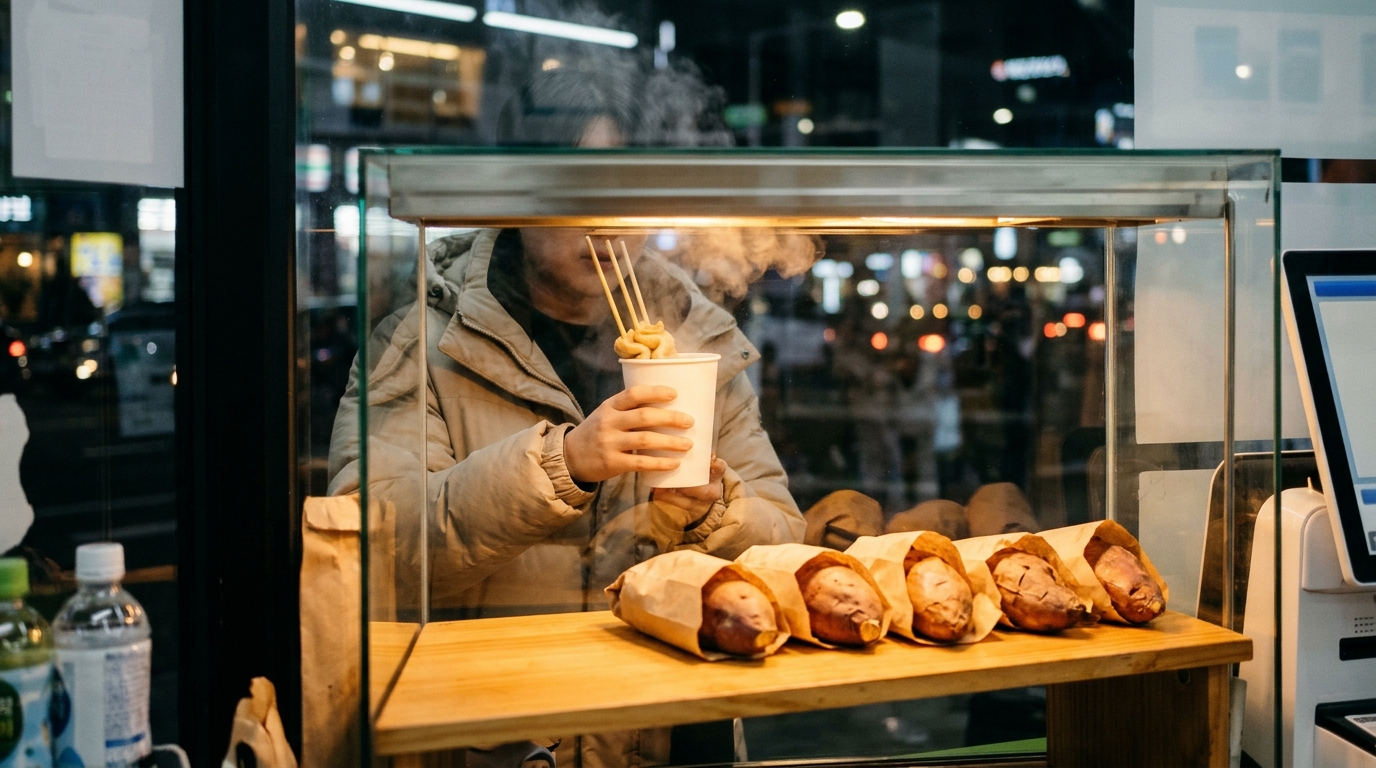
Throughout winter, convenience store entrances feature stone-roasting electric drawers that release a distinct sweet aroma. Korean sweet potatoes feature dense yellow flesh with a natural honey-like sweetness.
Seven-Eleven structured its 2026 lineup around high-moisture Hofungmi sweet potatoes in autumn before shifting to cured Beniharuka varieties in December. To increase value during cold snaps, Seven-Eleven raised average sweet potato portion weights by 30g while holding the price steady at ₩2,200. Served in thick paper sleeves for ₩2,200, these hot roots double as hand warmers outdoors.
4. CU Mijungdang Water Rice Cake (Mulgteok, 물떡)
Adapted from Busan's street market tradition, mulgteok consists of dense cylinder rice cakes simmered directly inside hot fish cake broth until tender. CU offers a nationwide retail version produced with Mijungdang, available in original savory broth (Eomuktang-mat) or spicy sauce (Maeun-mat) for ₩3,000.
The mild, chewy rice cake offers a gentle flavor profile that works well for travelers seeking regional Busan street food with mild spice levels.
5. Instant Hot Udon Cups (Cup Udon, 컵우동)
During sub-zero days, packaged instant cup udon offers immediate heat. Unlike standard dry ramyeon noodles, retail cup udon features fresh, vacuum-sealed wheat noodles and concentrated liquid dashi stock.
Established items such as Tukbaegi Udon and CJ Katsuo Udon run between ₩2,500 and ₩3,500. Add boiling water from the store dispenser up to the marked fill line, microwave for 90 seconds, and top with the included crispy tempura flakes (tenkasu).
6. Hot Counter Fried Chicken & Skewers (Chikin & Hot Bar)
GS25, CU, and Seven-Eleven maintain heated glass display cabinets beside cash registers containing fried chicken portions, spiced sausage skewers (hot bar, 핫바), and cheese-filled cutlets. The boneless fried chicken thighs sold at GS25 cost under ₩2,500 and rival dedicated fast-food chains in crunch and juiciness.
Items selected straight from the cashier's heated display cabinet are warm and ready to eat. If selecting a pre-packaged version from refrigerated shelves, heat it in the microwave for 30 to 40 seconds.
7. The Taehyung Combo Noodle Hack (Taehyung Jeongsik, 태형 정식)
Popularized by BTS member V (Kim Taehyung) on television broadcasts like CJ ENM's Freehan 19, this customized store meal combination keeps total cost under ₩5,000 (usually coming to roughly ₩4,700).
How Do Promotional Deals and Store App "Keep" Functions Work for Winter Snacks?
Chains regularly run monthly sales incentives, notably "1+1" (buy one, get one free) and "2+1" (buy two, get one free) deals on warm drinks, udon cups, and deli skewers. Buyers do not need to consume all items in a single sitting.
Franchise networks manage multi-buy deals through mobile apps, such as GS25's Naman-ui Naengjanggo ("My Own Refrigerator") or CU's Pocket CU. When paying for a deal at checkout, ask the cashier to apply the "Keep" (보관, bogwan) feature. The remaining promotional item gets stored as a mobile app barcode, redeemable at any matching chain location across South Korea within 30 to 90 days.
Regarding broth policies: purchasing any fish cake skewer for ₩1,000 to ₩1,800 grants free use of the warm broth tap for cup refills at the counter.
What Dietary Warnings and Ingredients Should You Watch Out For?
Checking ingredient labels remains essential for travelers with dietary restrictions, as seafood extracts and pork byproducts are common across Korean winter food lines.
- Halal Considerations: Most fried chicken and savory meat buns contain non-halal poultry or pork fats. Sweet red bean hoppang and roasted sweet potatoes offer reliable meat-free choices.
- Pork Derivatives: Lard and gelatin are common components in pizza hoppang and hot bar sausages. Look for pork (dweji-gogi, 돼지고기) on printed ingredient panels.
- Seafood Allergies: Crustacean and dried shrimp powders (sae-u, 새우) are frequently processed on shared equipment with rice cake broths.
Travelers with severe allergies or medical conditions should check labels using translation apps before heating food, and consult a medical doctor or pharmacist if unexpected allergic reactions occur while traveling.
Tourist Logistics: Hours, Instant Tax Refunds, and Payment Methods
Convenience stores operate 24 hours a day across South Korea, making them convenient sources for late-night hot meals. Guidance from the T-Money Official Convenience Store Guide notes that standard transit cards are accepted for all hot food purchases.
When spending ₩15,000 or more on a single receipt at designated stores carrying the "Immediate Tax Refund" sign, present your physical passport to the clerk. The cashier will scan the passport and deduct the 10% Value Added Tax (VAT) directly at payment.
To explore traditional street dining context outside retail chains, reading an overview of Korean Winter Street Food offers helpful perspective on how neighborhood food culture shifted into modern retail branches.
Frequently asked questions
Q. Can I pay with a foreign credit card or T-money card at Korean convenience stores?
All major Korean convenience store chains accept international credit cards like Visa and Mastercard without minimum spend requirements. Travelers can also tap T-money or WOWPASS transit cards at checkout counters to pay for hot food and drinks.
Q. Is hot fish cake broth free at Korean convenience stores?
Purchasing a fish cake skewer (*eomuk*) at GS25 or CU includes free refills of hot broth in paper cups at the counter. Taking broth without buying a skewer is against store etiquette.
Q. How do I heat up food in a Korean convenience store if I don't speak Korean?
Korean convenience store microwave stations feature straightforward buttons labeled with heating durations in seconds. Complete payment at the register first, place the item inside, and press the 30-second or 1-minute button following package guidelines.
Q. What is the difference between Hoppang and Jjinppang?
Hoppang (호빵) is the commercial brand name for steamed buns sold in heated convenience store cabinets. Jjinppang (찐빵) refers to traditional, hand-made steamed buns typically sold at outdoor markets and traditional street bakeries.
Q. Can foreign tourists get an instant Tax Refund at GS25 or CU?
Participating convenience stores displaying tax-refund signs offer instant VAT deductions for foreign tourists spending ₩15,000 or more on eligible retail items in one purchase. Customers must show a physical passport at the register before paying.