Seoul Cherry Blossom Guide: Yeouido & Seokchon Lake Dates
Key takeaways
Seoul cherry blossom season peaks between early and mid-April, featuring top festival sites at Yeouido's 1.7 km Yeouiseo-ro boulevard and Seokchon Lake's 2.5 km water loop. Visitors should bypass crowded subway exits, use Naver Map instead of Google Maps, and carry KRW cash for street stalls. As of 2026, foreign tourists can use the Climate Card Tourist Pass starting at ₩5,000 per day for unlimited public transit.
This Seoul Cherry Blossom Guide shows that catching peak bloom in the city boils down to timing and knowing how to get around the crowds. Opening buds usually appear in late March, with full bloom taking over Seoul between early and mid-April before petals start falling a week later. This guide sets out exact walking routes, transit rules, app setups, and backup viewing spots for international travelers visiting Yeouido and Seokchon Lake during spring.
Seoul Cherry Blossom Forecast & Bloom Mechanics
Cherry blossoms (beotkkot / 벚꽃) across Seoul follow a tight annual schedule tied to early spring temperatures. Historical weather data and tracking from koreatodo.com show that first blooms generally appear between March 27 and April 5, reaching full bloom (manhae / 만개) 7 to 10 days later. For 2026, Korea Tourism Organization forecasts project initial blossoms in central Seoul around April 3, with peak volume expected around April 10.
Once trees reach full bloom, the peak viewing window lasts just 4 to 7 days. Spring rain showers or sudden cold winds can cut that window short by triggering "cherry blossom rain" (beotkkot-bi / 벚꽃비). Keep in mind that micro-climates across the city vary slightly, as paved urban areas and southern slopes warm up faster than shaded mountain spots like Namsan.
| Location | Average First Bloom | Average Peak Bloom | Key Feature |
|---|---|---|---|
| Yeouido (Yeouiseo-ro) | Late March / Early April | April 5 – April 12 | Riverfront canopy road & food stalls |
| Seokchon Lake | Late March / Early April | April 3 – April 10 | Twin lake loop & Lotte World backdrop |
| Namsan Park | Early April | April 8 – April 15 | Higher altitude, later blooming window |
| Seoul Forest | Late March / Early April | April 4 – April 11 | Wide park spaces & King Cherry trees |
Yeouido Cherry Blossom Festival: Navigating Yeouiseo-ro & Avoiding Crowds
The Yeouido Cherry Blossom Festival (Yeouido Bomkkot Chukje / 여의도 봄꽃축제) stands as Seoul's largest spring gathering, drawing over 3.5 million visitors to the Han River (Hangang / 한강) banks. At the center of it all is Yeouiseo-ro (여의서로), a 1.7-kilometer road behind the National Assembly building that closes to vehicles so pedestrians can walk beneath 1,886 Korean Yoshino cherry trees.
Escaping the Yeouinaru Subway Exit Bottleneck
The most common operational mistake visitors make at Yeouido is exiting through Yeouinaru Station on Line 5. On peak weekends, Yeouinaru Exits 2 and 3 get packed, creating long lines just to get out to street level. Local authorities routinely step in to enforce one-way foot traffic inside the station and along nearby park trails.
To skip the gridlock, try these alternate routes:
Street Food Stalls, Mat Rentals & Nearby Hotspots
Temporary vendor stalls line the outer edge of Yeouiseo-ro and spill down into Yeouido Hangang Park, serving up street foods like tteokbokki (spicy rice cakes / 떡볶이), eomuk (fish cake skewers / 어묵), and grilled chicken skewers (dakkochi / 닭꼬치). Vendors also offer plastic picnic mats (jari / 자리) for rent at roughly ₩5,000 to ₩10,000 as of 2026. Right next to the park sits The Hyundai Seoul (더현대 서울), the city's largest flagship department store, giving visitors a quick option for indoor dining and air-conditioned rest.
Seokchon Lake Cherry Blossom Guide: Photo Spots & Walking Routes
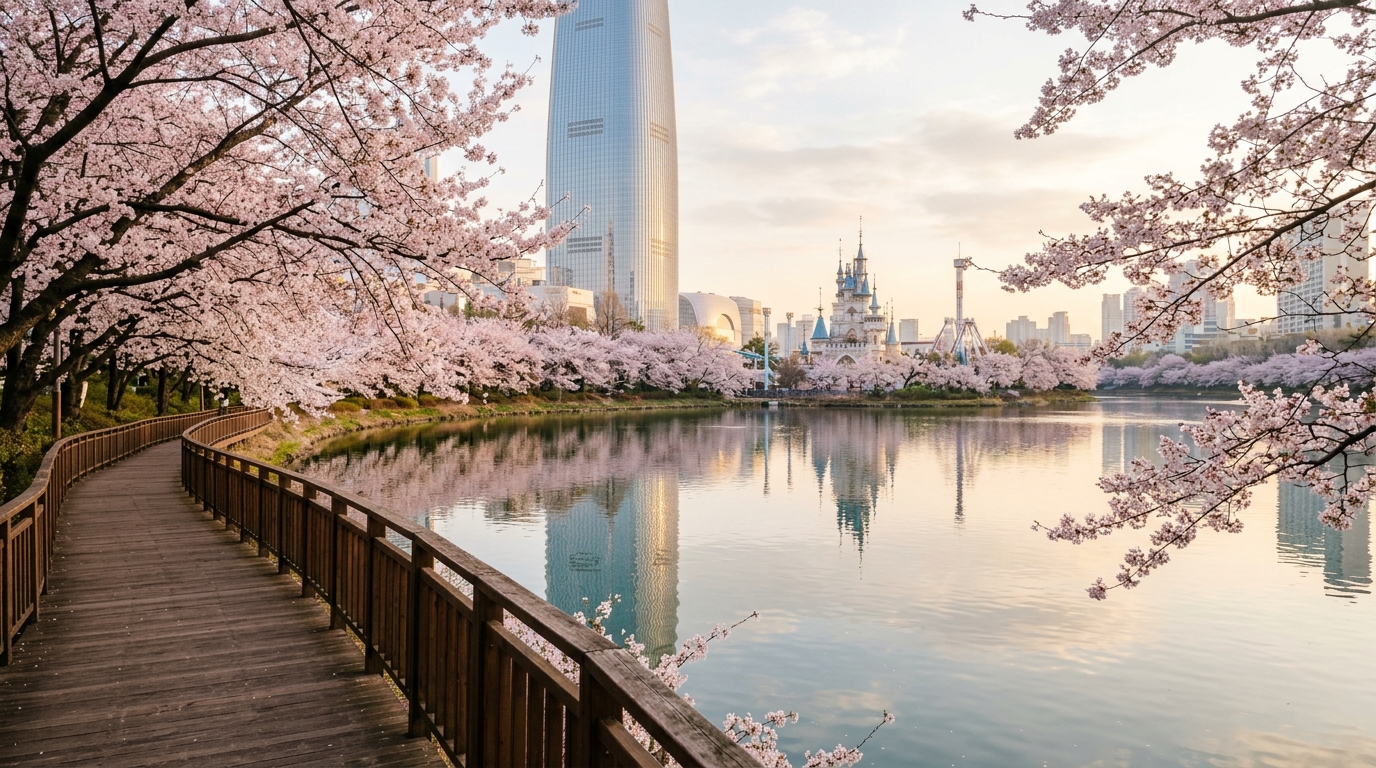
Down in the southeastern Songpa-gu district, Seokchon Lake (Seokchon-hosu / 석촌호수) features a 2.5-kilometer walking loop lined with more than 1,100 cherry trees. Unlike Yeouido's wide boulevard layout, Seokchon Lake forms a canopy directly over the water, framing two striking landmarks: Lotte World Magic Island and the 555-meter Lotte World Tower.
East Lake vs. West Lake: Framing Lotte World & Lotte World Tower
Seokchon Lake splits into two distinct basins linked by pedestrian underpasses under the Songpa-daero bridge. Official travel guides on visitseoul.net highlight how each side presents a unique view:
- West Lake (Seo-ho / 서호): Wraps around Lotte World Magic Island. The classic shot here captures pink blossoms in the foreground with the fairytale castle turrets rising out of the lake. It fills up early as photographers position themselves to shoot the ride drop towers against the blossoms.
- East Lake (Dong-ho / 동호): Sits right below Lotte World Tower. Pathways are wider here, offering expansive angles looking straight up at Korea's tallest skyscraper breaking through the pink canopy.
Optimal Photography Angles and Time Slots
Timing your visit makes a noticeable difference in light quality and crowd management. Key photography windows include:
Day vs. Night Cherry Blossom Viewing in Seoul
Viewing cherry blossoms in Seoul offers two completely different feels depending on the hour. Day visits bring out contrast between clear skies, fresh spring green foliage, and pale pink flowers. At night (yagan-beotkkot / 야간벚꽃), local crews turn on spotlighting along the paths at Yeouido and Seokchon Lake, transforming the tree canopy into illuminated tunnels.
| Viewing Window | Temperature & Atmosphere | Crowd Density | Best For |
|---|---|---|---|
| Early Morning (7:00 AM – 10:00 AM) | Crisp (8°C–12°C), calm and quiet | Low | Photography, peaceful walks, fast movement |
| Afternoon (12:00 PM – 5:00 PM) | Warm (15°C–20°C), energetic, festival atmosphere | Peak / High | Picnic dining, street performances, shopping integration |
| Night (7:00 PM – 10:30 PM) | Cool (10°C–14°C), illuminated canopy | Medium-High | Date walks, night photography, evening dinners |
Temperatures around the Han River and Seokchon Lake drop fast after sundown. Packing an extra jacket or layer helps, as water breezes make it feel cooler than daytime highs suggest.
Essential Visitor Logistics: Maps, Transit Cards & Cash Realities
Foreign travelers arriving in Seoul for blossom season usually run into three main friction points: broken map directions, public transit card choices, and cash requirements at outdoor stalls.
Why Google Maps Fails in Korea (And What to Use Instead)
South Korea's spatial data security regulations limit geographic data exports, meaning Google Maps cannot offer accurate turn-by-turn walking or driving navigation in the country. It often shows outdated spots or broken foot paths. Foreign travelers must download Naver Map or KakaoMap prior to arrival for accurate transit routing. Both apps support English, show real-time subway arrivals, and provide reliable turn-by-turn walking routes.
Climate Card Tourist Pass vs. T-Money
Getting around on subways, city buses, and taxis relies on contactless smart cards. Visitors can choose between two primary card options:
- T-money Card (티머니): The traditional rechargeable card. You can pick one up at convenience stores like GS25, CU, or Seven-Eleven for ₩3,000 to ₩5,000 as of 2026, then reload cash as needed. Remaining balances can be refunded at participating stores before departing.
- Climate Card Tourist Pass (Gihu Donghaeng Card / 기후동행카드): Launched by the Seoul Metropolitan Government, this pass provides unlimited subway and city bus travel within Seoul for fixed multi-day periods.
Note on Climate Card limits: The Climate Card covers all Seoul subway lines inside city limits, but excludes the Shinbundang Line and regional buses going outside Seoul. For standard blossom itineraries centered on Yeouido and Seokchon Lake, the Climate Card Tourist Pass delivers solid value.
Cash Requirements for Festival Vendors
South Korea is largely cashless in brick-and-mortar shops, cafes, and taxis, where foreign credit cards work seamlessly. Outdoor festival pop-ups work differently. Independent street food stalls, flower crown sellers, and picnic mat rentals around Yeouido and Seokchon Lake generally cannot process foreign credit cards. They rely on local mobile bank transfers or physical Korean Won (KRW) cash. Carrying ₩20,000 to ₩40,000 in cash per person ensures you can buy snacks and rent mats without issue.
Plan B: Late-Season King Cherry Blossoms (Gyeop-Beotkkot)
If your travel dates fall in mid-to-late April after standard Yoshino trees have shed their petals, pivot your plans toward King Cherry Blossoms (gyeop-beotkkot / 겹벚꽃). These trees produce double-layered, deep pink blossoms that open roughly one to two weeks later than single-layer varieties.
According to urban park information on visitkorea.or.kr, top spots for late-blooming King Cherries include:
- Boramae Park (보라매공원): Located in Dongjak-gu, with dense stands of deep pink King Cherry trees around the main lawn.
- Seoul Forest (서울숲): Located in Seongdong-gu, offering late double blossoms near the deer area and cultural grounds.
- Seoul Grand Park (서울대공원): Situated in Gwacheon (Line 4), where elevated terrain keeps bloom windows open into mid-April.
Picking transit routes that bypass station bottlenecks, setting up Naver Map early, holding physical cash for outdoor stalls, and keeping late-season King Cherry spots in reserve ensures a smooth spring trip regardless of slight shifts in the weather.
Frequently asked questions
Q. When is the best time to see cherry blossoms in Seoul?
The ideal viewing window in Seoul typically occurs between April 3 and April 12, with peak bloom lasting roughly 4 to 7 days around April 10. Timing varies slightly each year based on spring temperatures, so monitoring real-time bloom updates in early April is recommended.
Q. Which site is better for cherry blossoms: Yeouido or Seokchon Lake?
Choose Yeouido for a classic street festival experience with wide walking avenues, street food vendors, and riverfront picnics. Choose Seokchon Lake for iconic lakeside photo framing of Lotte World Magic Island and Lotte World Tower along a continuous 2.5 km water loop.
Q. How do I avoid crowds at Yeouido Cherry Blossom Festival?
Avoid exiting at Yeouinaru Station (Line 5) on peak bloom weekends. Instead, take Line 9 to National Assembly Station (Exit 1 or 6) or walk from Yeouido Station (Exit 5). Arriving before 9:30 AM on weekdays provides the quietest experience along Yeouiseo-ro.
Q. Does Google Maps work for walking to cherry blossom spots in Seoul?
No, Google Maps does not support turn-by-turn walking or driving navigation in South Korea due to national spatial data laws. Travelers should download Naver Map or KakaoMap, which provide accurate English transit routing, walking paths, and real-time subway schedules.
Q. What happens if I miss peak cherry blossom week in Seoul?
If standard Yoshino blossoms have fallen, visit sites with King Cherry trees (*gyeop-beotkkot*), which bloom 1 to 2 weeks later in mid-to-late April. Premier late-blooming locations in the capital area include Boramae Park, Seoul Forest, and Seoul Grand Park.