How to Watch the Bosingak New Year's Eve Bell Ceremony
Key takeaways
The Bosingak New Year's Eve Bell Ceremony is Seoul's official midnight countdown event, featuring 33 strikes of a historic bronze bell at Bosingak Pavilion to welcome the new year. While Line 1 trains bypass Jonggak Station after 23:00 for safety, visitors can reach the free street festival via nearby stations like Gwanghwamun or Euljiro 1-ga, with extended subway operations running until 02:00 AM on January 1.
What is the Bosingak New Year's Eve Bell Ceremony?
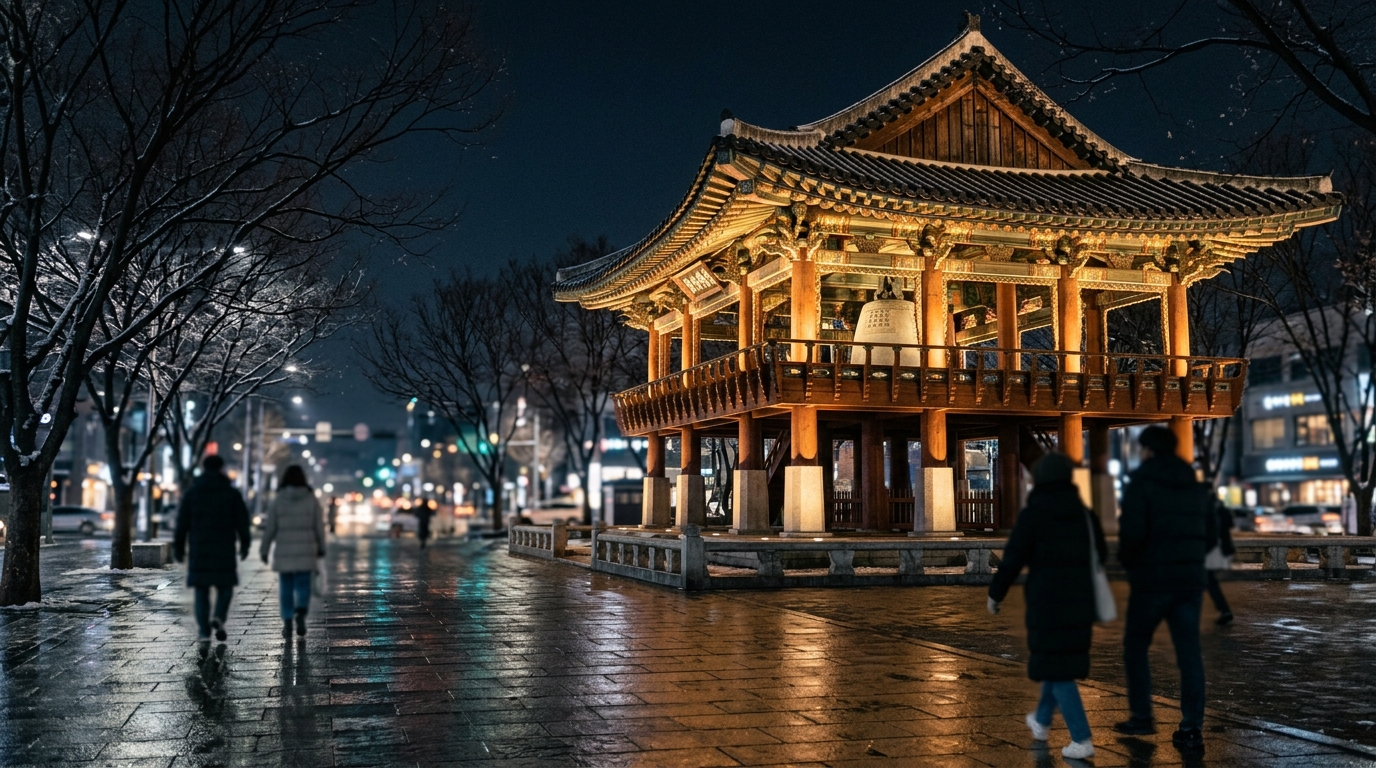
Every December 31 at midnight, Seoul marks the start of the new year at Bosingak Pavilion in central Jongno. During the ceremony, civic leaders and chosen citizen representatives toll a massive bronze bell 33 times to signal the arrival of January 1.
The custom of striking the bell 33 times at midnight on December 31 began in 1953, shortly after the Korean War, as a public gesture of hope, peace, and national renewal. The 33 bell tolls root back to Buddhist cosmology, symbolizing the 33 heavens (Trāyastriṃśa) and bringing peace, health, and good fortune for the new year.
Back in the Joseon era (1392–1910), the bell served a practical purpose in municipal management. It rang 28 times at nightfall (Injeong, 인정) to signal the closing of Seoul's eight fortress city gates, then 33 times at dawn (Paru, 파루) to mark their morning opening. While city walls no longer regulate traffic, the midnight ringing on December 31 remains a deep Korean tradition.
The original 1468 bronze bell survived fires and wars before moving to the National Museum of Korea in 1985 due to structural wear. The bell heard today is a 1985 replica funded by public donations. Weighing roughly 20 tons, it produces a deep resonance that echoes across downtown Jongno. Official background details from the Seoul Metropolitan Government official history page explain that citizen representatives—including local heroes, firefighters, and international figures—are selected each year to pull the wooden ram.
When and Where Does the Bosingak Midnight Countdown Happen?
The ceremony takes place at Bosingak Pavilion, right at the Jongno 1-ga intersection in downtown Seoul. Street activities run from 22:30 on December 31 through 00:30 on January 1. Attending the street festival is completely free, with no tickets or reservations required.
While the main bell ringing happens at midnight, street events start hours earlier. Stage performances begin around 22:30 near the pavilion under the Seoul Winter Festa banner. The lineup features traditional Korean drumming (gugak, 국악), K-pop dance teams, citizen choirs, and light shows.
The final countdown starts at 23:59:30 on December 31. Once midnight hits, the 33 bell strikes ring out across the avenue over roughly 10 to 12 minutes, accompanied by laser projections, cheering crowds, and digital wish screens.
| Event Phase | Expected Schedule | Key Activities & Operational Details |
|---|---|---|
| Area Traffic Control | 18:00 | Major vehicle traffic closures begin around Jongno 1-ga intersection. |
| Pre-Ceremony Stage Shows | 22:30 – 23:50 | K-pop dance, traditional drumming, citizen choir, and light shows. |
| Midnight Countdown | 23:59:30 | Digital crowd countdown broadcast across giant LED displays. |
| 33 Bell Tolls | 00:00 – 00:12 | The bell is struck 33 times by citizen representatives and city leaders. |
| Post-Midnight Show | 00:12 – 00:30 | Congratulatory performances and ambient street light displays. |
| Dispersal & Extended Transit | 00:30 – 02:00 | Crowd clearance; extended subway and city bus operations until 02:00 AM. |
How Do You Get to Bosingak When Trains Skip Jonggak Station?
Getting to Bosingak on New Year's Eve requires a short walk from neighboring subway stops like Gwanghwamun, Anguk, or Euljiro 1-ga. Because Line 1 trains bypass Jonggak Station during late peak hours, planning an alternate route keeps you out of major crowd bottlenecks.
The critical transit detail for travelers is the station bypass. Line 1 trains completely bypass Jonggak Station without stopping between 23:00 and 01:00 on New Year's Eve to prevent dangerous platform crowding. Exits 1 through 12 at Jonggak are locked and staffed by safety personnel during this window.
To reach the viewing area, get off at a nearby station and walk 5 to 10 minutes to Jongno 1-ga:
Road closures cover Jong-ro, Ujeongguk-ro, and Cheonggye-bukro from 18:00 on December 31 to 07:00 on January 1. Buses normally running through Jongno divert to parallel roads like Eulji-ro or Yulgok-ro.
For late travel, Seoul Metro and key downtown bus routes extend their operational hours until 02:00 AM on January 1, offering late-night transport home. Still, last trains from downtown stations pass between 01:40 AM and 01:55 AM. Hailing a taxi near Jongno after midnight is exceptionally difficult because of road blocks and high demand. If using Kakao T, expect long waits or walk several blocks past the traffic boundary before requesting a ride.
Since Google Maps does not provide complete walking or transit directions in South Korea due to national map data laws, download Naver Map or KakaoMap before heading out. Top up your T-money card with cash before 22:00 to skip midnight ticket line queues. Double-check logistical updates on VisitSeoul's Bosingak guide.
What Should You Expect on the Ground in Seoul on December 31?
Expect dense spectator crowds, structured pedestrian lanes, freezing winter weather, and active security management by city authorities. The mood is energetic but controlled.
By 22:00, space immediately surrounding Bosingak Pavilion reaches full capacity. Seoul Metropolitan Government sets up one-way walking channels and metal barriers to keep emergency routes open. Spectators cannot stand inside the elevated wooden pavilion structure itself; crowds gather along the closed avenues outside.
If you arrive close to midnight, marshals will direct you toward overflow viewing zones along Sejong-daero or Cheonggyecheon Stream. High-definition LED screens and audio relay setups along main routes allow people farther away to follow the countdown clearly.
What Winter Gear Do You Need for Seoul's Sub-Zero Midnight Cold?
Midnight temperatures in central Seoul on December 31 average between -5°C and -10°C (23°F to 14°F), and wind chill makes standing outdoors feel noticeably colder. Proper thermal layering is essential.
Unlike walking tours, standing on cold pavement for two to three hours drains body heat quickly through shoes and coats. Preparing gear ahead of time makes a huge difference.
For a brief warm-up, 24-hour convenience stores (CU, GS25, Seven-Eleven) sit along side streets in Insadong and Euljiro. Stores right next to Jongno fill up fast close to midnight, so grab hot drinks and heat packs before entering the main event zone. Additional area recommendations can be found on The Soul of Seoul.
Bosingak vs. Other Seoul New Year's Eve Events: Which Should You Choose?
Bosingak hosts Seoul's traditional cultural countdown, Lotte World Tower focuses on skyscraper lighting and fireworks, and Dongdaemun Design Plaza (DDP) highlights digital media art projections.
Depending on your group size, walking tolerance, and interest in historic heritage versus modern shows, Seoul offers several distinct options.
| Celebration Hub | Core Highlight | Crowd Density | Firework Show | Ideal For |
|---|---|---|---|---|
| Bosingak Pavilion | 33 Bronze Bell Tolls & Cultural Stages | Extremely High | No (Laser & Light Show) | History lovers, first-time Korea visitors, energetic adult travelers |
| Lotte World Tower (Jamsil) | Skyscraper Laser & Light Countdown | High | Selective / Targeted Fireworks | Families, couples, photography fans wanting modern cityscapes |
| Dongdaemun Design Plaza (DDP) | Media Art Projection (Seoul Light) | Moderate | No | Art fans, design enthusiasts, travelers preferring open movement |
| Gwanghwamun Square | Seoul Winter Festa Broadcast & Light Art | Very High | No | Visitors wanting central access with wider walking paths |
Because Bosingak sits in a crowded historic district, large fireworks are skipped for safety reasons. The experience focuses on traditional bell strikes, street performances, and laser projections instead.
How Can You Ring the Bosingak Bell Yourself During Daytime?
Visitors can join a free daytime bell-ringing session at Bosingak Pavilion held Tuesday through Sunday at 12:00 noon, run by the Seoul Metropolitan Government.
If midnight crowds in sub-zero weather do not match your travel plans, the regular daytime bell-ringing event (Bosingak Sangseol Tajong Event, 보신각 상설타종행사) offers a hands-on alternative.
Participants wear traditional Joseon-era military guard robes (subungun, 수문군), tour the upper floor of the pavilion structure, and strike the bronze bell alongside staff.
Walk-in registrations are sometimes accepted for foreign passport holders if pre-booked guests do not show by 11:45 AM, though booking online in advance guarantees entry.
Frequently asked questions
Q. What time should I arrive at Bosingak on New Year's Eve?
Arrive between 21:30 and 22:30 on December 31 to secure a viewing spot near the pavilion before surrounding pedestrian streets reach peak capacity.
Q. Is Jonggak Station open on December 31 night?
Seoul Subway Line 1 trains bypass Jonggak Station without stopping from 23:00 to 01:00 on New Year's Eve to manage crowd safety, so you must use nearby stations like Gwanghwamun (Line 5) or Euljiro 1-ga (Line 2).
Q. Are there fireworks at the Bosingak New Year's Eve ceremony?
No traditional fireworks are launched at Bosingak due to safety regulations in the historic downtown area; the midnight celebration features laser lights, digital screens, and stage performances instead.
Q. How cold does it get in Seoul on New Year's Eve?
Midnight temperatures typically range from -5°C to -10°C (23°F to 14°F) with cold wind chills, making windproof coats, thermal base layers, and heat packs essential for standing outdoors.
Q. How do I return to my hotel after midnight in Seoul?
Seoul Metro subway lines and select city bus routes extend service until 02:00 AM on January 1, with last train departures from downtown stations around 01:40 AM to 01:55 AM.