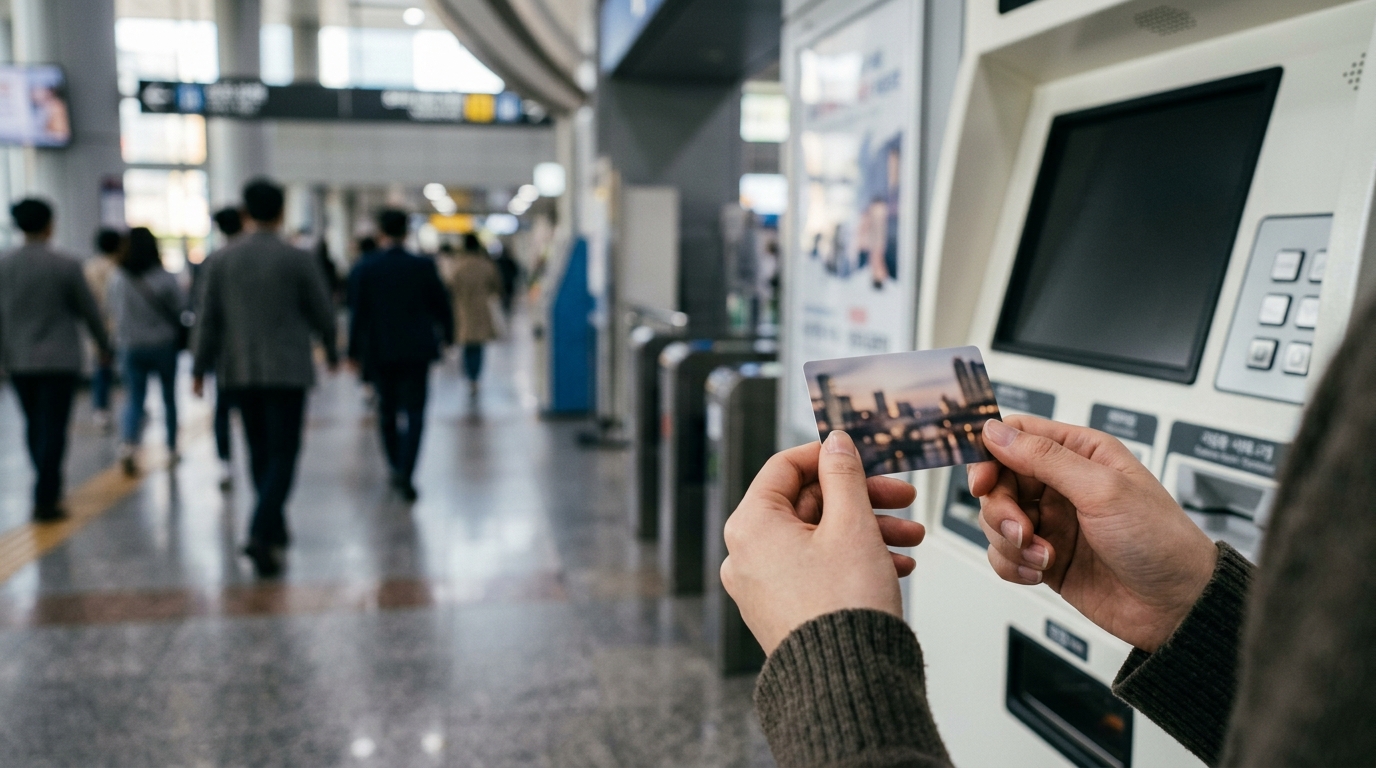
Book KTX Train Tickets with a Foreign Card: Full Guide
Key takeaways
To book KTX train tickets with a foreign card without error, international travelers should use Korail's official English web portal or authorized resellers like Klook and Trip.com rather than the native domestic app. As of October 2026, tickets go on sale 60 days in advance at 07:00 KST, with standard adult fares from Seoul to Busan starting at ₩54,400. Guest checkout requires only a passport number and a 3D-Secure enabled international credit card.
When you try to book KTX train tickets with a foreign card, avoiding payment rejections comes down to choosing the correct web platform over domestic mobile apps. International travelers can secure high-speed rail seats through Korail's global portal or authorized booking agencies without a Korean ID or local phone number. As of October 2026, Korail allows passengers to reserve seats up to 60 days in advance, making cross-country travel between Seoul, Busan, and regional hubs straightforward to plan.
How KTX Online Booking Works for Foreign Visitors
Booking high-speed rail in South Korea as an international tourist does not require a resident registration number (주민등록번호) or a Korean mobile plan. Korea's national rail operator, Korail (한국철도공사), runs both a domestic reservation service and an official global portal designed specifically for non-residents. On September 1, 2026, Korail integrated service schedules with SR, allowing travelers to search and book both KTX trains from Seoul Station or Yongsan Station and SRT (Super Rapid Train) trains from Suseo Station through consolidated schedule systems.
Unlike local residents who use member logins, foreign visitors purchase tickets as a Guest. You simply enter your full name as printed on your passport, your passport number, nationality, and an email address where your electronic ticket PDF will be sent.
As of October 1, 2026, Korail expanded its advance booking window from 30 days to 2 months (60 days). Ticket inventory for the newest available date releases sharp at 07:00 KST every morning. For travelers heading along high-demand corridors like Seoul to Busan on Friday afternoons or weekend mornings, booking immediately at the 60-day mark ensures access to prime departures and standard seating before peak slots sell out completely.
How to Avoid Foreign Card Rejections and Checkout Failures
To prevent foreign card rejections during KTX online checkout, you must avoid using the native Korean mobile app (Korail+) and process your booking via the official Korail Global Web Portal or authorized international agency platforms. The domestic Korail+ app relies on Korea's PASS authentication system, which silently blocks transactions if the card details do not match a Korean mobile provider identity verification step.
When using international Visa, Mastercard, or JCB credit cards on Korail's English website, payment failures are usually triggered by 3D Secure (3DS) authentication drops or browser pop-up blockers interrupting the bank verification screen.
Here is a platform comparison for international travelers:
| Platform Channel | Foreign Card Success Rate | Korean Phone Needed? | Seat Selection Ability | Cancellation Flexibility |
|---|---|---|---|---|
| Korail Global Web Portal | High (requires 3D Secure) | No | Automatic / Limited Map | Official Korail refund terms |
| Authorized Reseller (Klook) | Very High | No | Automatic Express | Instant refund via reseller app |
| Reseller (Trip.com) | Very High | No | Manual seat map picking | Subject to agency policy |
| Native Korail+ Mobile App | Fails for foreign cards | Yes (PASS app) | Full manual seat map | Full refund options |
If your issuing bank requires multi-factor authorization during checkout, ensure pop-up windows are enabled in your browser settings so the 3D Secure prompt can launch cleanly. Alternatively, authorized third-party platforms like Klook or Trip.com bypass Korean banking pop-ups altogether by processing payments through standard international payment gateways. Klook issues instant e-tickets direct to its app, while Trip.com allows international buyers to interact with manual seat maps to choose specific windows or aisles without needing local credentials.
KTX Seat Selection: Backward Seats, Power Outlets, and the Car 5 Hack
Selecting the best seat on a KTX train depends on the specific train model serving your route. Korea operates four distinct high-speed train models: the original KTX-1, KTX-Sancheon (KTX-산천), KTX-Eum (KTX-이음), and the high-speed KTX-Cheongryong (KTX-청룡).
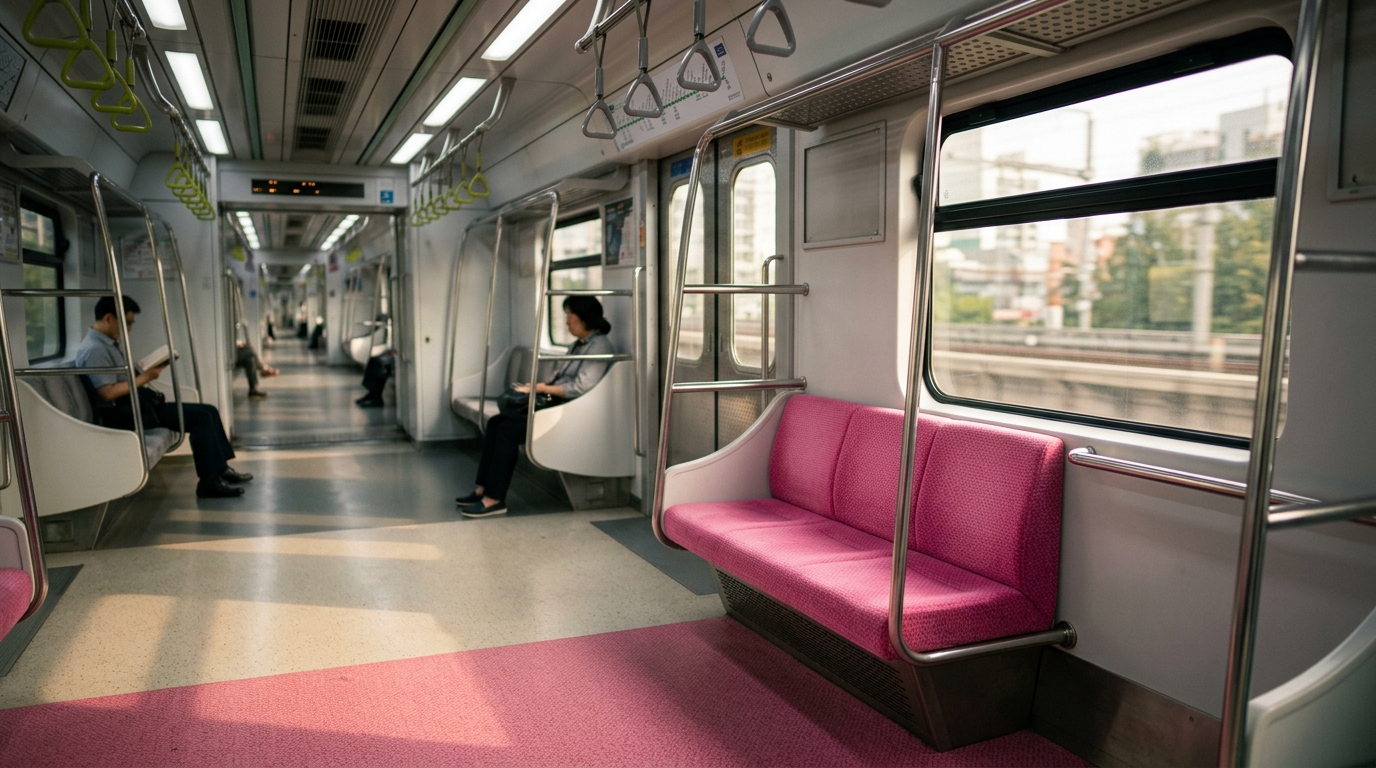
On original KTX-1 trains, half of the standard seats face backward relative to the train's direction of travel and cannot rotate. However, smart travelers use Car 5 (5호차) on KTX-1 trains because it was converted from First Class into Standard Class, offering single-seat rows and extra legroom at standard prices.
| Train Model | Seat Direction | Power & USB Outlets | Notable Interior Features |
|---|---|---|---|
| KTX-1 (Original 20-car) | 50% Forward / 50% Backward (Fixed) | Wall sockets between window pillars | Car 5 features former First Class legroom and single seats |
| KTX-Sancheon | 100% Forward-facing (Rotating) | 1 AC outlet & 2 USB ports per row | Smoother ride, quieter cabins, wider seats |
| KTX-Eum | 100% Forward-facing (Rotating) | Wireless charging pads & USB at every seat | Operating on central routes (Gangneung/Andong) |
| KTX-Cheongryong | 100% Forward-facing (Rotating) | Dedicated AC & USB port for every individual passenger | Korea's fastest train (speeds up to 320 km/h) |
Understanding the operational differences between train models helps avoid uncomfortable journeys. Original KTX-1 trains consist of 20 cars where non-rotating seats face toward the center of each car, leaving half the seats permanently facing backward. In contrast, newer models like the KTX-Sancheon, KTX-Eum, and KTX-Cheongryong feature fully rotatable seating rows, guaranteeing 100% forward-facing configurations. On the KTX-Eum, serving regional corridors like Gangneung and Andong, passengers also enjoy wireless phone charging pads built directly into the seating rows, while the flagship KTX-Cheongryong provides individual dedicated AC power and USB ports for every single passenger.
KTX Luggage Rules: Racks, Oversized Bags, and On-Board Etiquette
Standard passenger tickets on KTX trains include full allowance for personal luggage without requiring advance seat reservations or extra baggage fees. Korail permits passengers to bring up to two large bags with maximum combined dimensions (length + width + height) of 158 cm and a weight limit between 20 kg to 30 kg per bag.
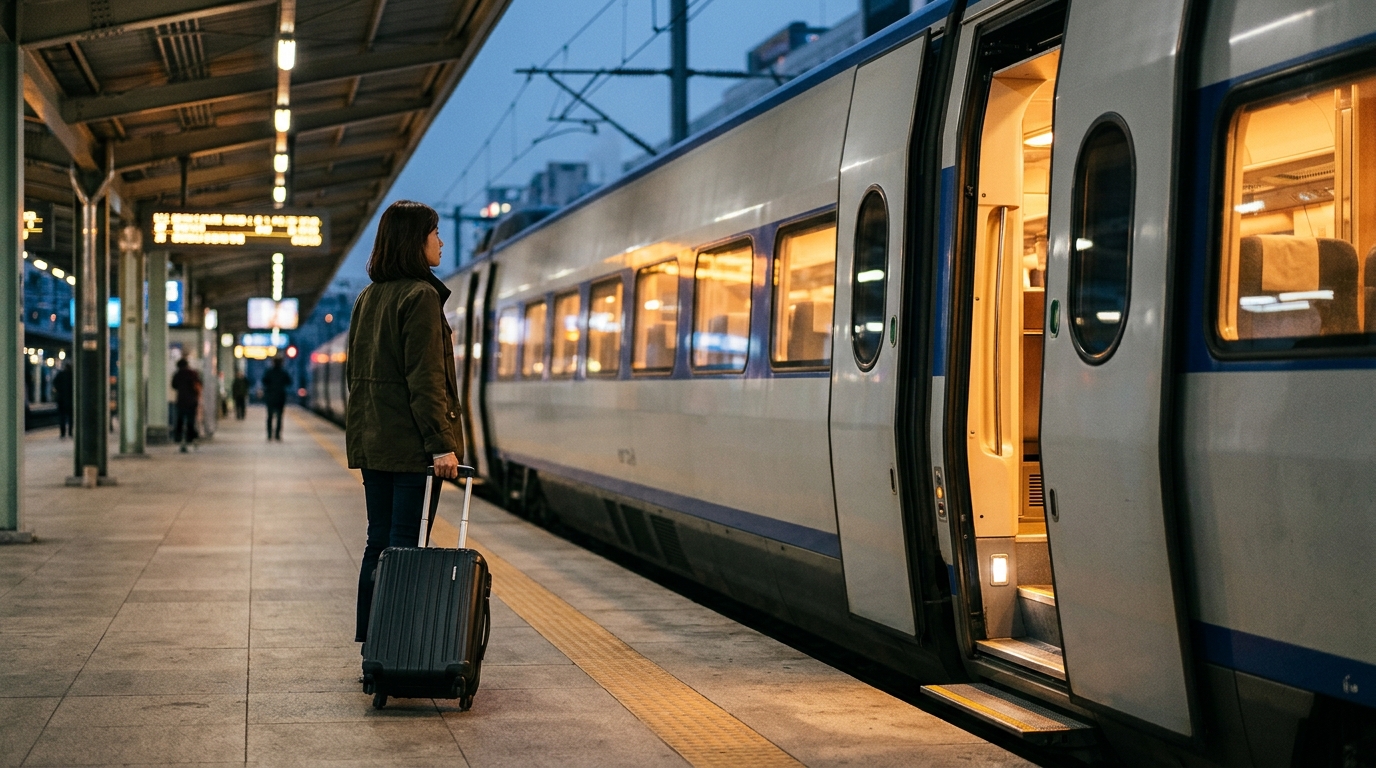
Unlike high-speed trains in some other Asian countries where oversized luggage slots must be pre-booked, KTX train cars feature luggage storage racks in the entry vestibules between cars on a first-come, first-served basis. Overhead luggage shelves above passenger seats can comfortably fit carry-on rolling suitcases and backpacks up to 22 inches long.
To ensure a comfortable journey for everyone, keep the following etiquette rules in mind:
For travelers carrying heavy 28-inch to 30-inch hard-shell suitcases, placing bags on the luggage racks located right near the car entry doors is straightforward. To keep your luggage secured during high-speed travel, place heavy suitcases flat on their sides on the bottom rack level rather than standing upright, preventing them from shifting when the train decelerates into stations.
Ticket Fares, Route Schedules, and Korail Pass Savings
Traveling between major cities in South Korea via high-speed rail is cost-effective when planned around standard point-to-point ticket prices or multi-day tourist rail passes. According to Korail official updates as of September 2026, standard fares across primary corridors are standardized to provide affordable cross-country travel.
| Route Corridor | Standard Class Fare (Adult) | First Class Fare (Adult) | Approximate Travel Time |
|---|---|---|---|
| Seoul to Busan (서울-부산) | ₩54,400 | ₩83,700 | 2 hours 15 mins to 2 hours 45 mins |
| Seoul to Dongdaegu (서울-동대구) | ₩39,000 | ₩56,600 | 1 hour 40 mins |
| Seoul to Gangneung (서울-강릉) | ₩27,600 | ₩38,600 | 2 hours |
| Seoul to Gwangju-Songjeong (서울-광주송정) | ₩42,000 | ₩65,200 | 1 hour 50 mins |
For tourists visiting multiple cities within a short window, purchasing a Korail Pass (KR PASS) can offer significant savings. The pass grants unlimited KTX travel for either consecutive days (2 or 3 days) or select days within a 10-day window.
A 3-day consecutive Korail Pass costs ₩186,000 and does not break even on typical three-leg trips like Seoul to Busan, Busan to Gyeongju, and back to Seoul, which cost ₩114,700 in total as individual tickets.
If your travel plans change, Korail provides flexible cancellation refund terms based on how early you cancel before train departure:
| Cancellation Timing | Refund Fee (Weekday) | Refund Fee (Weekend & Holiday) |
|---|---|---|
| 1 month to 2 days before departure | Free (₩0) | ₩400 administrative fee |
| 1 day before departure | Free (₩0) | 5% of ticket fare |
| Departure day up to 3 hours prior | Free (₩0) | 10% of ticket fare |
| Under 3 hours prior to departure | 5% of ticket fare | 20% of ticket fare |
| After departure (at ticket counter only) | 15% to 70% penalty | 15% to 70% penalty |
Effective September 2026, standard adult fares for the primary Seoul-to-Busan route stand at ₩54,400 for Standard Class and ₩83,700 for First Class. When choosing between single point-to-point tickets and a KR PASS, evaluate your itinerary: a 2-Day Select Pass or 3-Day Consecutive Pass allows users to reserve up to two train seat tickets per day at no added cost directly through the Korail global website. With the integration of SRT routes into the central Korail platform, foreign tourists can now compare schedules departing from Seoul Station, Yongsan Station, or Suseo Station within a single search interface, simplifying transit planning across metropolitan Seoul.
Understanding how to easily book KTX train tickets foreign card options ensures your journey through South Korea remains seamless from the moment you land. For your next step, explore our practical guides on navigating Seoul Station transfers and purchasing a local transit card for city subway travel.
Frequently asked questions
Q. Can I use an international credit card to book KTX train tickets online?
Yes, foreign tourists can use Visa, Mastercard, or JCB credit cards on Korail's official English web portal or through authorized travel platforms like Klook and Trip.com. When booking on the official site, ensure your foreign card supports 3D Secure authentication to pass the bank verification step.
Q. Why does the Korail website or app keep declining my foreign card?
The native Korail+ mobile app declines foreign credit cards because it requires identity verification via Korea's local PASS mobile authentication system. To prevent card rejections, international travelers must use a browser to access the Korail Global web portal or purchase tickets through third-party platforms.
Q. How far in advance can tourists book KTX tickets?
As of October 2026, Korail allows passengers to book KTX tickets up to 60 days (2 months) in advance. New ticket seats are released daily at 07:00 KST (Korea Standard Time) across official websites and partner reservation platforms.
Q. How do I make sure my KTX seat faces forward?
Newer train models like KTX-Sancheon, KTX-Eum, and KTX-Cheongryong feature 100% forward-facing rotating seats. On original KTX-1 trains, half the seats are fixed backward, so choose seats labeled forward on the map or select Car 5 for converted First Class legroom.
Q. Are there extra baggage fees or reservations required for large suitcases on KTX?
No extra fees or advance seat reservations are required for oversized luggage on KTX trains. Passengers can bring up to two large bags (up to 158 cm combined dimensions and 30 kg each) for free, using storage racks located in the vestibules between train cars.