The End of Noisy Fans? How Solid-State Cooling Chips Are Changing Laptop Thermal Management
 AI-generated image
Key takeaways
Solid-State Cooling Chips are semiconductor-based cooling modules that dissipate heat by creating high-speed air jets through ultrasonic piezoelectric membrane vibrations without spinning fan blades. Featuring an ultra-thin profile under 2.8mm and near-silent operation around 21 dBA, they are driving the era of sub-10mm ultra-slim AI laptops.
The annoying fan noise when turning on a laptop and the creep of heat from the base have long been a persistent nuisance. Solid-State Cooling Chips boldly do away with spinning fan blades altogether. By generating high-speed micro-jet airstreams inside a razor-thin chip measuring barely 2.8mm, they solve thermal issues from the ground up.
As of September 2026, solid-state cooling technology is no longer confined to laboratory research; it is actively being deployed in commercial ultra-slim laptops and mobile devices. The paradigm of PC cooling is shifting rapidly.
 AI-generated image
What Are Solid-State Cooling Chips That Promise to End the Era of Noise and Dust?
Solid-state cooling chips are semiconductor-based active cooling modules that pull in and expel air using ultrasonic vibrations, completely without bearings or spinning blades. Unlike conventional cooling fans that generate airflow by spinning blades inside bulky housings, these chips operate using an ultra-thin MEMS (Micro-Electro-Mechanical Systems) structure that is only 2.5mm~2.8mm thick.
Solid-state cooling chips such as AirJet® by Frore Systems clearly overcome the limitations of traditional cooling methods.
- Noise Reduction: Eliminates mechanical friction and vortex noise from spinning blades, creating a virtually silent environment imperceptible to the human ear.
- Ultra-Slim Profile: Measuring under 3mm thick, it enables the design of ultra-thin laptops under 10mm.
- High Back Pressure: High pressure density ensures that cooling performance does not easily degrade even when high-density dust filters are attached to the air intakes.
How Do They Generate Airflow Without Blades? The Principle of Ultrasonic Vibration and Jet Streams
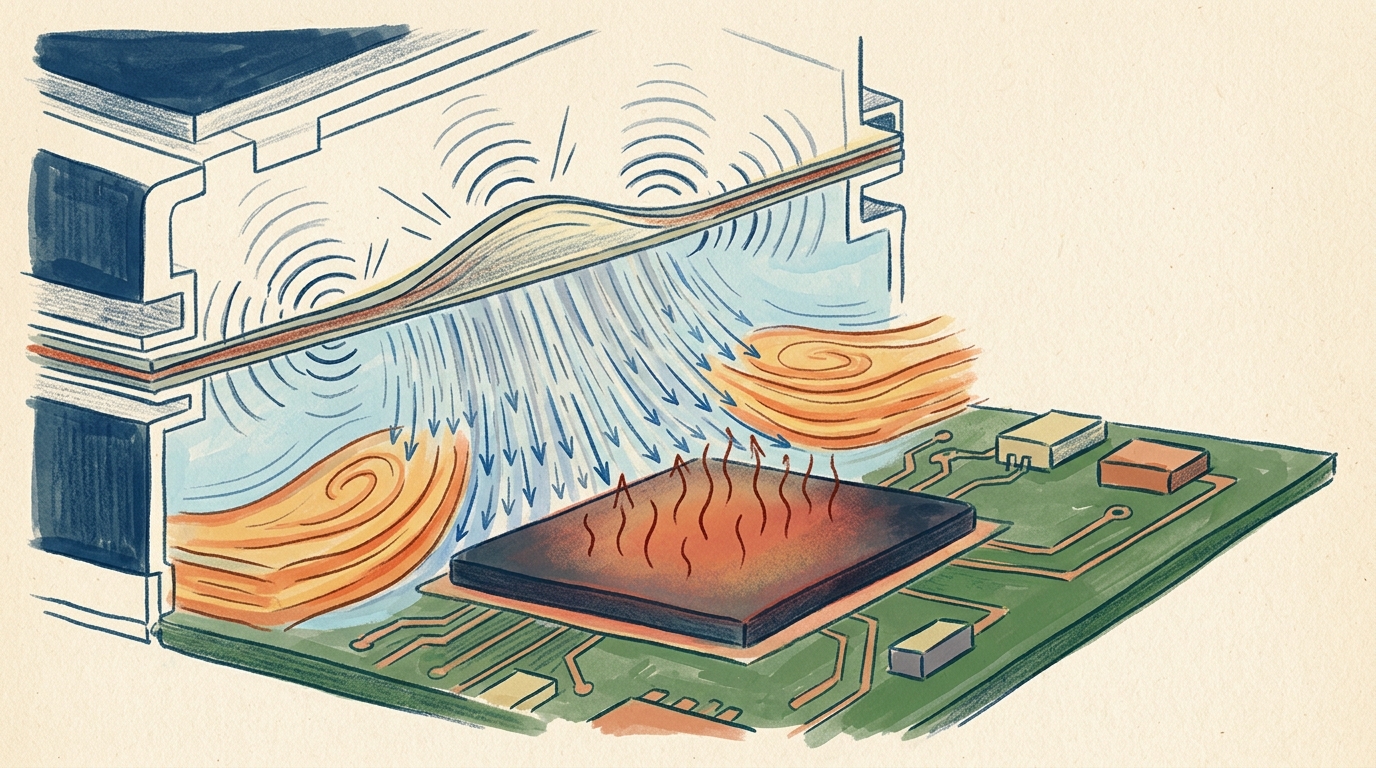
Solid-state cooling chips vibrate internal piezoelectric membrane films at ultrasonic frequencies, creating high-speed jet streams through air pressure differentials generated when voltage is applied. Known in engineering as 'Jet Impingement,' this process pulls air in from the top of the chip and blasts it toward the board surface at speeds exceeding 200 km/h.
According to How-To Geek's technical analysis, this operating process is divided into three main stages:
- Ultrasonic Membrane Vibration: When powered on, the piezoelectric elements vibrate at ultrasonic frequencies far too fast for the naked eye to see.
- Air Intake via Pressure Differential: As the membrane repeatedly expands and contracts, it pulls in ambient air through top apertures.
- Jet Stream Discharge & Boundary Layer Disruption: The intake air passes through micro-nozzles at the bottom and is discharged at high speed onto the heat spreader. This directly breaks through the tough Thermal Boundary Layer on the surface, rapidly dissipating heat.
Although the internal membrane moves minutely, there are no wearing moving parts like motors or gears, and because it is manufactured using semiconductor processes, it is called 'solid-state' cooling.
 AI-generated image
Conventional Rotary Fan vs. Frore Systems AirJet: Spec Comparison
Solid-state cooling chips outperform traditional rotary fans in thickness, weight, and back pressure, delivering exceptional thermal dissipation efficiency even in cramped spaces.
The table below summarizes the key specification differences between a standard laptop cooling fan and the Frore Systems AirJet Mini module.
| Feature | Conventional Laptop Rotary Fan | Solid-State Cooling Chip (AirJet Mini) |
|---|---|---|
| Module Thickness | 7.0mm ~ 12.0mm | 2.5mm ~ 2.8mm |
| Single Module Weight | Approx. 25g ~ 40g | 7g ~ 8g |
| Operating Noise | 35 dBA ~ 50 dBA | 21 dBA ~ 24 dBA (Near-silent) |
| Max Back Pressure | Approx. 150 Pa ~ 300 Pa | 1750 Pa (Approx. 10x higher) |
| Single Module Heat Dissipation | Varies by fan size (approx. 5W~10W) | 5.25W ~ 7.5W (Scalable with multi-chip arrays) |
| Dust/Water Filter Compatibility | Filter use limited due to pressure drop | Compatible with IP58-rated high-density filters |
Thanks to its high back pressure of 1750 Pa, it forcefully drives airflow even through fine dust filters or water-resistant barriers.
The Reality of Sub-10mm Ultra-Slim Laptops: Lenovo AeroBlade & Intel Reference Case Studies
By 2026, solid-state cooling chips have moved beyond paper concepts to become core components in high-performance ultra-slim laptops hitting the market.
According to a Tom's Hardware report, Intel demonstrated a 11.3mm reference laptop based on its Wildcat Lake architecture at Computex 2026. Equipped with AirJet modules, it handled 15W of sustained heat dissipation and up to 30W peak dissipation silently.
Similarly, Lenovo's AeroBlade revealed on Ubergizmo showcased a stunning form factor under 10mm thick and weighing under 830g. Despite having no fan vents on the bottom panel, it runs on-device AI workloads stably without thermal throttling.
Can They Replace High-Power Gaming Laptops? Limitations and Future Outlook
Solid-state cooling chips are optimized for thin and light ultrabooks and AI PCs operating in the 15W~30W range; replacing cooling systems in high-power gaming laptops exceeding 100W remains challenging due to cost and horizontal footprint constraints.
Cooling the 150W+ heat output of a gaming laptop would require arraying 20 or more solid-state cooling chips together, which presents several practical hurdles:
- MEMS Manufacturing Cost: Because they rely on semiconductor manufacturing processes, production costs are higher than molded plastic rotary fans, impacting initial mass adoption speed.
- Horizontal Surface Footprint: While extremely thin, they expand horizontally, making placement alongside large-capacity batteries quite tricky.
Nevertheless, in 2026, as on-device AI computing becomes everyday practice, Solid-State Cooling Chips have established themselves as an irreplaceable cooling solution in thin-and-light premium laptops and mini PCs—delivering maximum power in lightweight designs alongside a refreshingly silent user experience.
Frequently asked questions
Q. Are solid-state cooling chips truly silent?
Operating noise ranges between 21 and 24 dBA, which is near the threshold of human hearing and quieter than a whisper (30 dBA). For all practical purposes, it is virtually silent.
Q. Without fan blades, is clogging from internal dust or debris an issue?
Solid-state cooling chips generate a back pressure of around 1,750 Pa—roughly 10 times higher than traditional fans. Thanks to this powerful pushing force, airflow remains unblocked even when using IP58-rated high-density dust filters, fundamentally preventing dust buildup.
Q. Do ultrasonic vibrations affect humans or household pets?
They are engineered outside the hearing frequency range of humans and pets like dogs and cats. Additionally, vibration energy remains encapsulated within the chip's internal structure, preventing harmful acoustic vibrations from escaping.
Q. When can consumers actually buy laptops equipped with solid-state cooling chips?
The Lenovo AeroBlade and Intel reference model unveiled in 2026 are proof-of-concept and reference designs. Mass production and retail availability for general consumer laptops have not yet begun.