Differences Between 3-Cushion and 4-Ball Billiards & Large Table Score Calculation Guide
Key takeaways
A complete guide covering ball size and rule differences between 3-cushion and 4-ball billiards, full-size table handicap conversion, and PBA bank shot rules. It also details average-based handicapping, along with essential etiquette and beginner precautions.
What are the key differences between 3-cushion and 4-ball billiards?
In 4-ball, players score by directly hitting two object balls using four balls measuring 65.5 mm in diameter. In contrast, 3-cushion (three-cushion) uses three balls measuring 61.5 mm in diameter, and the cue ball must contact cushions at least 3 times before striking the second object ball. In particular, international full-size tables (Dadae) have a larger table area and lower cloth friction, so winning comes down to finer tip placement and thinner cut-shot control compared to medium tables.
Although they may look similar at first glance, these two disciplines differ significantly from ball sizes and table specs to scoring criteria. Medium tables commonly found by hobbyists and international full-size tables played by professionals have large differences in cushion rebound angles and roll performance, requiring entirely different tactical approaches.
- Ball Specs and Weight: 4-ball balls are heavy, with a diameter of 65.5 mm and a weight of about 240 g. On the other hand, balls designed exclusively for 3-cushion are smaller and lighter, with a diameter of 61.5 mm and a weight of about 205~210 g, making them ideal for delicate spin transfer and hitting thin edges.
- Table Specifications: While the inner dimensions of a medium table are about 1,270 mm × 2,540 mm, an international full-size table is much larger at 1,422 mm × 2,844 mm. Underneath the slate of a full-size table, precision heating wires are installed to help the balls roll consistently.
- Scoring Method and Foul Criteria: In 4-ball, points are scored only by directly striking the two red balls, while hitting the opponent's cue ball results in a foul (hiro). In 3-cushion, however, the opponent's cue ball is recognized as a valid object ball, so striking it is not a foul at all.
Here is a clear breakdown of the spec differences between the two disciplines.
| Category | 4-Ball Match | 3-Cushion Match |
|---|---|---|
| Ball Diameter / Weight | 65.5 mm / Approx. 240 g | 61.5 mm / Approx. 205~210 g |
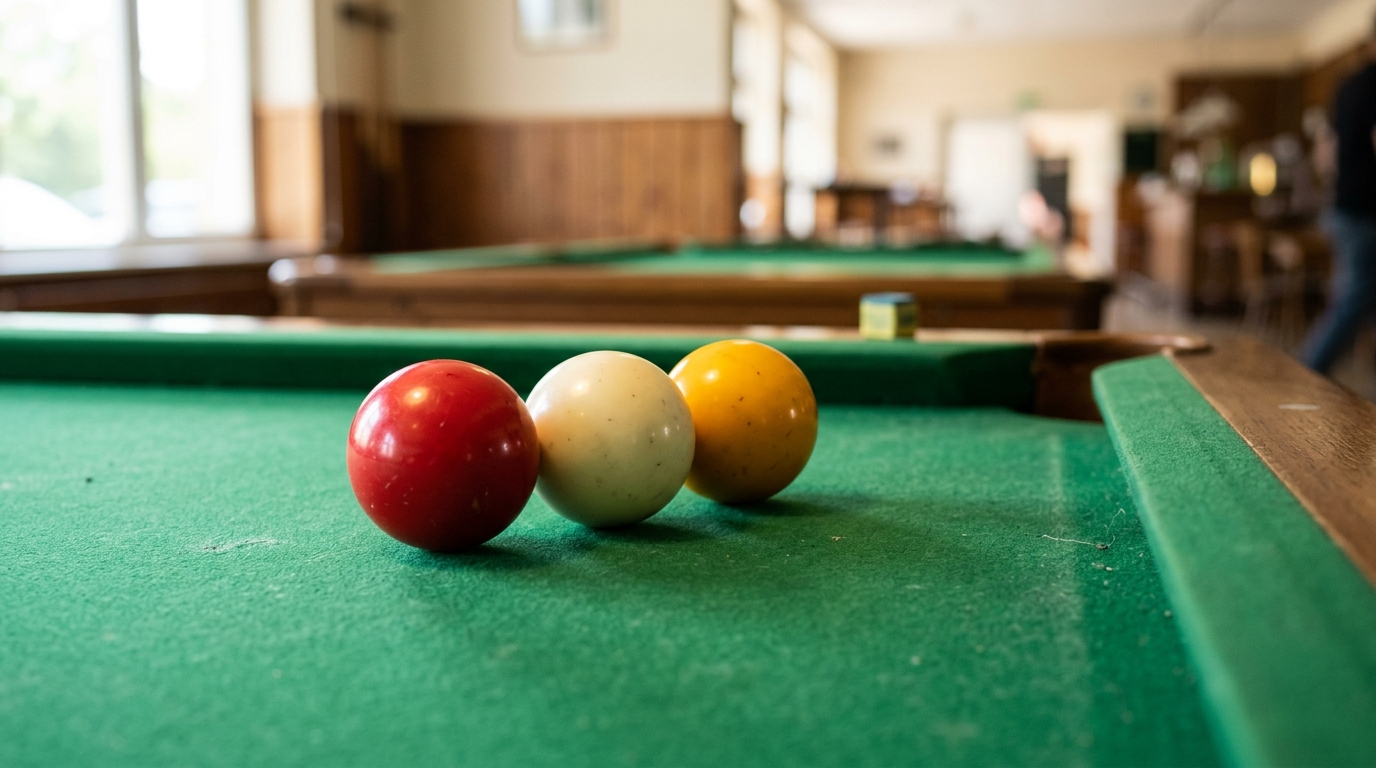
| Number of Balls Used | 4 in total (2 red, 1 white, 1 yellow) | 3 in total (1 red, 1 white, 1 yellow) |
| Primary Table | Medium Table | International Large Table |
| Basic Scoring Condition | Strike 2 red balls directly with cue ball | Complete at least 3 cushions before/after hitting object balls |
| Striking Opponent Ball | Foul applied (penalty point and end of inning) | Valid score recognized (no foul) |
How do I calculate my full-size table 3-cushion handicap from my 4-ball score?
Dividing your 4-ball score by 10 usually gives your 3-cushion score on a medium table. When transitioning this score to a full-size table, it is common to set it 2~4 points lower to account for table rebound angles and higher difficulty. For example, a hobbyist who scores 150 points in 4-ball typically starts with a medium-table 3-cushion handicap of 15 points and an introductory full-size table handicap of around 12~13 points.
Setting a handicap is the first hurdle beginner players face when entering the world of full-size tables. Because full-size tables are larger and have excellent ball roll, attacking with the feel of a medium table will significantly lower your scoring probability.
Recommended introductory handicap guidelines for full-size tables based on 4-ball handicaps.
Most modern pool halls manage handicaps using digital scoreboards (CUSCO, BilliBoard, etc.). Here is useful reference data when setting your full-size table handicap based on average (average score per inning).
| 4-Ball Score | Recommended Medium Table 3-Cushion Score | Introductory Full-Size Table 3-Cushion Score | Target Average (AVG) |
|---|---|---|---|
| 100 points | 10 pts | 9~10 pts | 0.350 or lower |
| 150 points | 15 pts | 12~13 pts | Around 0.450 |
| 200 points | 20 pts | 15~16 pts | Around 0.550 |
| 250 points | 25 pts | 18~19 pts | Around 0.650 |
| 300 points | 30 pts | 20~22 pts | 0.750 or higher |
Club and federation guidelines widely use the formula Recommended Full-Size Table Handicap ≈ Average (AVG) × 25. Details can also be found in Tistory Billiards Guide or YouTube Billiards Lecture videos.
What are the basic scoring rules and bank shot rules in full-size table 3-cushion?
In full-size table 3-cushion, 1 point is awarded only when your cue ball contacts cushions at least 3 times while hitting both object balls. Successfully executing a bank shot—striking an open cushion before any ball—awards 2 points. Currently, the PBA professional league and domestic full-size table clubs adopt this 2-point bank shot rule as standard.
A standard match proceeds in the following sequence.
Key rule changes that beginners should keep in mind:
- 2-Point Bank Shot Rule: Utilizing open cushions—such as a '3-bank shot' hitting 3+ cushions before an object ball or a '1-bank shot' hitting 1 cushion then object balls—allows you to score 2 points at once.
- Using the Opponent's Cue Ball: Unlike 4-ball, using the opponent's ball (white or yellow) as a stepping stone for scoring does not result in a foul.
- Double Hit Foul and Miscues: Double hitting the ball (push shot) or miscueing off the cue tip immediately ends your turn.
For detailed rules, you can review guidelines at Tistory Billiards Rules Summary.
Top 3 mistakes 4-ball players make when starting full-size table 3-cushion
Players familiar with 4-ball frequently make cut-shot thickness errors due to ball size optical illusions, lose spin by hitting too hard, and feel a subtle hesitation when targeting the opponent's ball.
Even seasoned 4-ball veterans experience trial and error when stepping onto a full-size 3-cushion table due to differences in ball roll and stroke mechanics.
- Mistake 1: Aiming thick and pushing hard like in 4-ball In 4-ball, 65.5 mm balls retain plenty of spin even with a thick hit, but with 61.5 mm full-size table balls, even a slight thickness error drastically changes the deflection angle. Forcing a hard push shot will cause the ball to jump and drift much shorter than intended.
- Mistake 2: Stiff, abrupt stroke using high tip placement In 4-ball, techniques like hooking or short snappy shots using top-tip placement are common. In full-size table 3-cushion, however, a smooth and long follow-through with mid-to-low tip placement is far more stable.
- Mistake 3: Hesitating to hit the opponent's ball Lingering habits from 4-ball 'hiro fouls' often cause hesitation when targeting the opponent's yellow or white ball. In 3-cushion, if the position is favorable, you should confidently use the opponent's cue ball as object ball #1.
Check the following list before stepping up to the table:
Usage fees and etiquette guide for full-size billiard tables
Because international full-size tables require high installation and maintenance costs, fees are generally set around 2,000 KRW to 2,800 KRW per 10 minutes, with match data and averages recorded via digital scoreboards.
Since full-size table clubs generally value a quiet environment, it is best to follow basic playing etiquette. Below are standard environmental and price guidelines for major pool halls across Korea.
| Category | Standard Medium Table | International Full-Size Table |
|---|---|---|
| Average Rate per 10 Mins | 1,500 KRW ~ 2,000 KRW | 2,000 KRW ~ 2,800 KRW |
| Heated Slate Installed | Some tables | Precision heating required on all tables |
| Scoreboard System | Manual abacus or digital | Digital scoreboards (CUSCO / BilliBoard) |
| Recommended Dress & Etiquette | Casual attire | Quiet atmosphere, refraining from wearing caps/hats recommended |
Etiquette rules that full-size table club players should follow:
| Item | Recommended Etiquette Rule |
|---|---|
| Noise Control | Avoid loud talking or moving when opponent is attempting a break shot or difficult shot. |
| Drinks & Belongings | Do not place drinks or personal items on top of the table cushion rails. |
| Cue Management | Tapping your cue on the floor or poking the table after a shot is prohibited. |
| Score Entry | Press the game end button on the digital scoreboard after the match to check your average. |
Related information can also be found at Bravo E-Today Billiards Guide and Aha Knowledge Q&A.
Frequently asked questions
Q. If I play 150 points in 4-ball, what score should I set for 3-cushion on a full-size table?
It is ideal to start around 12–13 points, which is 2 to 3 points lower than your medium table 3-cushion score of 15 (calculated by dividing your 4-ball score by 10).
Q. Can you use 3-cushion balls and 4-ball balls interchangeably?
No, 4-ball balls are 65.5 mm in diameter, while 3-cushion balls are 61.5 mm. Because their sizes and weights differ, they cannot be used interchangeably.
Q. What does 'Average (AVG)' mean in 3-cushion billiards on a full-size table?
It is the average score calculated by dividing your total score by the total number of innings played, serving as an objective measure of a player's skill level.
Q. In 3-cushion, is it a foul to hit the opponent's ball first?
No. Unlike 4-ball, 3-cushion treats the opponent's cue ball as a valid object ball, so hitting it first is not a foul.
Q. How many points is a bank shot worth in full-size table 3-cushion?
Under PBA professional league and standard full-size table club rules, a successful bank shot that strikes a cushion first awards 2 points.